
Ben Affleck is right and wrong about AI in cinema
Mostly, he's wrong. Here's why.

Ben Affleck made a splash this week by sharing his opinions about artificial intelligence on Joe Rogan’s podcast. His comments show how someone can be right today and nevertheless be wrong about the future. There are useful lessons here for people who are interested in anticipating future trends, so let’s dig in.
Affleck and Matt Damon were on Rogan’s show to plug their new film, The Rip, a crime thriller set in the narcotics investigation team in Miami.
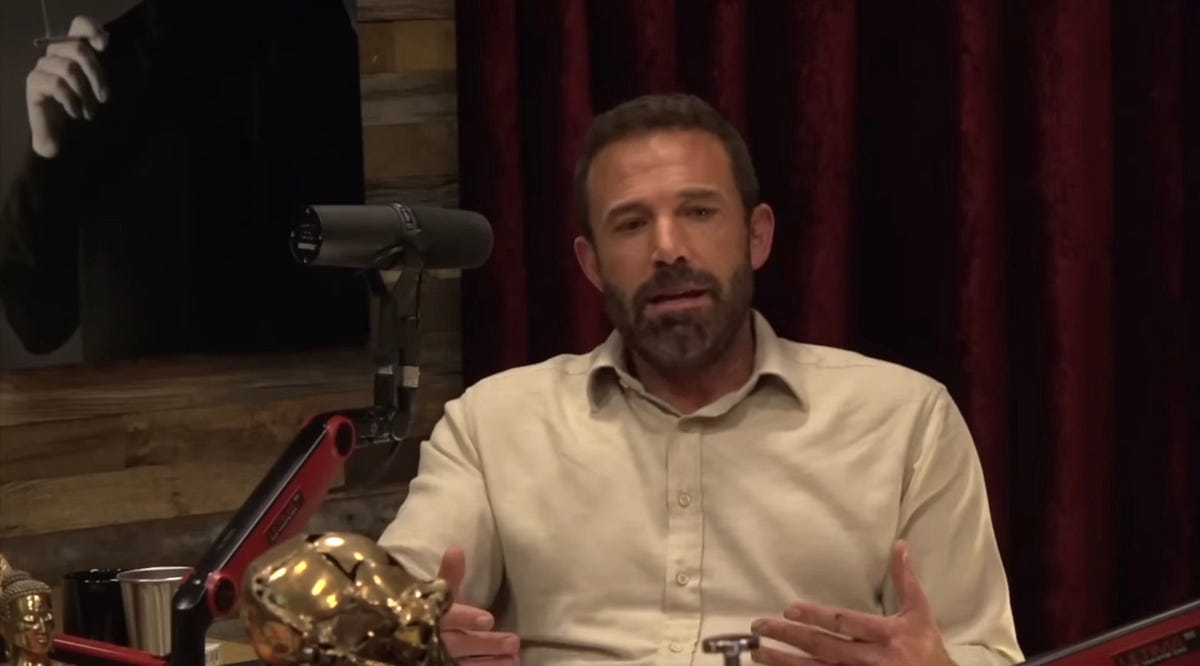
The interview was not focused on AI. It rambled across many topics. AI came up because Joe Rogan was trolling for soundbites to promote the episode; he hit paydirt with the AI topic. Affleck’s comments went semi-viral.
As an interviewer, Rogan is shrewder than his “doofus in a hoodie” shtick suggests. Like every successful talk show host, Rogan has a keen understanding of his audience. He knows what they are thinking, what they like, and what they loathe. His listeners are skeptical about AI hype, resentful of bullying by Big Tech, and envious of the Silicon Valley elite.
Rogan was playing to those sentiments when he asked Affleck about AI for filmmaking. And Ben was ready for the question.
Ben Affleck is a smart guy. Unlike his buddy Matt Damon, he did not attend Harvard, but he’s no slouch. Affleck has won two Academy Awards and enough Golden Globes and other industry awards to line several shelves in a private screening room. He is a quadruple threat: actor, screenwriter, producer and director. His films are intelligent and well crafted. He’s also an entrepreneur. He is a co-founder of the studio Artists Equity.
Affleck has strong views about artificial intelligence. He is dismissive of the quality of the output, doubtful about its potential, and quick to provide plausible-sounding explanations about why AI will never supplant human performers and human artistry.
None of his opinions are particularly novel nor unique, but they stand in sharp contrast to the feelings of fear and powerlessness that prevail among Hollywood’s creative professionals, who are already reeling from budget cuts, layoffs, and a decline in the number of new productions commissioned by the studios and networks. Here in LA, the outlook is gloomy.
Affleck stands out from his peers because he refuses to buy into the doomsday vibe. He explains his position clearly, with the authority of someone who knows what he is talking about. I know many people in the film and TV business; most of them would not be confident explaining how an LLM works on television or a podcast. Affleck is not afraid to do this.
Unfortunately, Ben’s confident remarks don’t withstand scrutiny.
What Ben Said
Let’s start by focusing on Affleck’s statements on the Joe Rogan Experience podcast:
AI is just a tool:
“AI, its going to be an tool, just like VFX"
"Instead of 500 guys in Singapore, making $2 dollars an hour to render all the graphics for a super hero movie. AI is going to do that a lot easier"
AI is not capable of generating meaningful creative work:
”I think it’s very unlikely that (AI) is going to be able to write anything meaningful, or that it’s going to be making movies from whole cloth, like Tilly Norwood. That’s bullshit.”
The quality of generative AI creative output is poor:
“If you try to get ChatGPT, Claude, or Gemini to write something, it’s really shitty, because by its nature it goes to the mean, to the average. I just can’t stand to see what it even writes”
There is no imminent threat to the creative industries:
”History shows adoption is slow. It’s incremental.”
“The guilds are going to manage this where it’s like 'if this is a tool that can actually help us.
”Guilds already protect human actors from being totally erased from certain films”
The quotes above cover the gist. Affleck had a lot more to say a lot about Guild rules and certain laws, like right to publicity laws, that he thinks will protect a celebrity’s name and likeness from appropriation by AI. He also had some clever things to say about AI hype and the inflated claims from companies like OpenAI.
See for yourself. This clip on The Verge will spare you the task of listening to the entire podcast.
Unpacking Ben’s Comments
Ben’s comments are not groundbreaking. They echo the conventional wisdom. Some of his remarks are an accurate assessment of where GenAI tools stood about one year ago. But, taken altogether, Ben is sending a signal to his peers in Hollywood that I think is dangerously misleading: he’s telling his listeners, “You don’t need to be concerned about this stuff. It is not a threat.”
In this article, I want to use Ben’s comments to convey why the motion picture industry, and Guild members in particular, should be very focused on generative AI, not as a threat but as a new capability. This is no time for complacency, and that’s why Ben is dead wrong even when he says things that sound reasonable.
One thing that Ben gets right about generative AI for filmmaking is that it is a tool for human artists, not a substitute for human artists. He has expressed this opinion before, but his comments seem to conflict: on the one hand, he is dismissive of AI tools and on the other, he is clear that it will, in fact, displace some human workers. For instance, in a previous interview, he pointed out that GenAI will generate special effects, such as creatures, aliens, superheroes, and exotic locations, far less expensively than the processes currently used by VFX studios, because the AI process will rely on far fewer human workers. For this reason, he said that he would not want to be in the VFX business.
On the other hand, his complaints about the quality of the output from AI tools suggest there is no immediate cause for alarm. He seems quite certain that AI will never reach his personal benchmarks for cinematic quality. He seems to be contradicting himself.
Let’s break this down.
As an experienced producer, Affleck knows that dollars saved in post-production can be redirected to the core task of performing the scene, thereby improving the overall product. So he’s providing a pretty strong clue about how he, as a film producer, would use AI. He sees GenAI as a tool to crush the VFX houses and reduce spending on computer generated imagery in order to free up budget for other creative work.
Ben might need to wait a couple more years before he can realize this ambition, however, because, as he admits, GenAI tools are not quite ready for professional movie making. Currently it is difficult to integrate AI tools into the moviemaking process.
The VFX business is all about making magic controllable, predictable and repeatable. Today, generally, AI tools fall short of that. The bar is high. Even AI tools that deliver high quality consistently don’t quite fit into the post-production workflow.
But that’s just today. This is moving very fast.
It’s risky to assume these flaws will linger into the future. This is where Ben goes wrong. His criticism seems to be focused on a lagging indicator: last year’s tools. To make an accurate estimate about the future impact of AI in any industry, one must begin with a clear understanding of the state of the art: what has improved, what hasn’t, where fresh progress is happening now, and when the tools overall will be good enough to eventually achieve professional results.
Affleck has not done this homework, and it shows. Judging from his remarks, he spent some time messing around with ChatGPT, Claude or Gemini, then gave up in frustration and concluded that all of the other AI tools probably suck. He made no reference to voice models like Eleven Labs, nor to video models like Runway ML, Luma, and Google’s Veo3, music models like Udio, or image generators like NanoBanana or Midjourney. It strikes me as a superficial analysis. These products are improving quickly.
Ben should know better: as a producer, his job is not dismiss a fledgling idea, but to come up with a way to make it work.
If he looked closer, he’d notice that remarkable improvement happened in 2025, and it is not limited to AI for video effects or text. Progress is happening across the entire field of generative AI simultaneously.
Relentless competition forces rapid quality improvements in AI. Competition among US tech firms; competition between US and Chinese tech companies; and competition between closed and open source software. It all adds up to a pressure cooker. Every AI model, as well as the emerging AI workflows and AI tool suites, are under immense pressure to improve rapidly, otherwise paying users will churn away to better products.
The AI arms race drives improvement at a pace that is clearly evident every month, sometimes even weekly. This is especially noticeable with the AI tools for video. Generated films today are noticeably better than films that were generated just a few months earlier.
Yes, of course, there remains plenty of room for improvement, but the clear signs of progress are unmistakeable if you pay attention.
Which means that any criticism of AI tools today will probably be out of date by the time you read about it. For instance, Ben airily dismissed OpenAI’s GPT-5 as a pricey flop, but he completely missed the radical improvement in Google Gemini and Anthropic Claude that occurred shortly after GPT-5 was released. He’s riffing.
This is how Ben goes wrong. It seems he can’t imagine a future where AI tools improve dramatically and quickly, and he does not notice when this actually happens. If it does not fit his narrative, he seems to disregard it. This weakens his argument.
Ben’s extrapolates that, because Generative AI tools have some flaws today, they will never, ever replace human actors, never replace studio film production on a sound stage, and never make it possible generate an entire feature film on a desktop computer.
Never is a very long time. Do you think Ben’s remarks will age well? I don’t.
He is also wrong about the adoption rate. He claims that adoption is slow. But AI uesrs are growing at a blistering pace. ChatGPT remains the fastest-adopted new technology in history. This seems like wishful thinking. This is the wrong moment for anyone in the motion picture industry to tune out the progress in AI.
“Never” is a blind spot
Affleck has fallen into the same trap of confirmation bias that has blinded studio heads for decades. The executives who manage motion picture companies have a keen understanding of the past and present, but in my experience, they tend to struggle when they try to imagine any alternative future scenario in which technology improves enough to displace or replace entire chunks of the creative process and distribution channels that they dominate. This is why they consistently are caught flatfooted by technological advances. This blind spot is why HBO failed to acquire Netflix (twice) and why no major media company owns YouTube. Even the existence of HBO is the byproduct of studio myopia.
Nobody likes to dwell on disaster scenarios. Transformative change feels a lot like a disaster to those who have the most to lose, which is why the folks in charge of studios tend to avoid it. They console themselves by saying, “That will never happen.”
That thought-terminating word, never, brings all speculation to an abrupt halt. But that habit of mind also tends to leave leaders unprepared for the moment when, surprise, surprise, the technology finally works.
Worse, leaders who presume “that will never happen” transmit their cognitive bias to their employees. Out-of-the-box thinking is discouraged. The organization’s capacity for innovation soon withers.
Blind to the future, the leadership of the biggest entertainment companies is trapped in a permanent present, where they assume next year will be just like last year. In any industry where technology improves at an exponential rate, this is risky. In Hollywood in 2026, this blind spot could be fatal.
(Below, I will explain how the movie studios are attempting to deal with blind spots, and why it is urgent that the Guilds do the same.)
AI needs creative humans
Ben is partially right in his remarks about the mediocrity of the writing and other output from LLMs today. But he wrongly attributes this defect to the technology. In 2026, bad output from an LLM is more likely a human error, not a machine error.
It is true that if a human user gives Claude or ChatGPT a lazy prompt, like “Generate an original script for a 90 minute buddy cop movie” they are likely to get a mediocre result. Garbage in, garbage out.
But this is only true if the human user is exceedingly lazy or unimaginative. A clever user can cajole the machine into surprising results. Successfully prompting an LLM to surpass its default mediocrity to deliver something fresh and creative requires a special kind of artistry that is deeply human.
Ben frames the usage scenario in the most simplistic way: an either-or binary. A or B. According to Ben, there are two possible futures: A) AI is confined to just one department, the VFX team; or B) AI is used to generate an entire film from scratch, just by pushing a button. He dismisses the latter as bullshit.
Neither of those two scenarios is plausible. Between them, there exists a wide range of possibilities in which generative AI is used in a variety of configurations throughout the entire process of filmmaking to reduce cost, speed up production and enhance creative ideation. The use cases range from screenwriting, plotting, backstory, world building, design, pre-visualization and pre-production; through principal photography and special effects; to post-production, editing and conform, scoring and sound design, mixing, mastering, marketing and promotion. Use of AI to streamline process and generate creative elements in all of these areas is already happening today, not necessarily by Hollywood professionals. Every one of these scenarios is more likely than the simplistic binary A or B scenario posited by Ben Affleck.
Nobody who is serious about extracting maximum performance from AI tools can afford to be as lazy as Ben suggests. If you are using AI for any professional task, you learn very quickly, on your first day, that getting good results from generative AI systems demands a lot of human creativity and innovative thinking.
What I mean is that it takes real creative skill to get creative results from an AI system. For instance: You must use language precisely to craft a good prompt. You must visualize clearly the outcome you desire, then find the words to convey that concept exactly to the machine. You must add in factual information and very specific detail, otherwise you may end up with a generic or bland result. AI is not embodied, so the human user must also supply the sensory input and emotional context or those elements will be missing from the final output. You can push an LLM out of its default mode by acting like a director and casting the AI into a specific role, like “You are a wiseass 17 year old with a sardonic sense of humor,” or “You are an experienced TV writer with more than 7 seasons on a police procedural” or “You are a research assistant whose job is to evaluate this draft script for historical accuracy and identify anachronisms and errors.” You can also create a virtual writer’s room by casting the AI into multiple personae, each commenting on a script from a particular vantage point. You can ask the AI to be a harsh critic and attack the weak spots in your script. You can feed it huge prompts filled with historical detail. You can direct the AI to refer to specific writing styles or famous works. You can equip the AI with a set of basic principles and guidelines, such as the story bible for a fictional world or elaborate backstories for individual characters, and instruct it to never deviate from these guardrails. I know writers who craft elaborate reference material and 1000 word prompts, and dump all of it into the context window to ensure that the AI has everything it needs to deliver optimal results.
In fewer words: AI demands some hard work. Creative work.
Quality output is definitely possible with generative AI, but it requires genuine creative effort from human users.
Your mileage may vary. It’s not my intention to give readers a formula or a prescription. There are a multitude of different techniques for getting good results from LLMs. Endless prompt recipes are available on the web. Try them. Use whichever you prefer.
My point is: if your plan is to use an AI to generate creative work, then you’d better be prepared to do some of the heavy lifting yourself. You cannot outsource creativity entirely to a machine. Collaborating with a machine intelligence is a different kind of creative task that demands new skills; but if you put in even a little bit of effort, you will be rewarded with satisfactory creative results with AI as your writing partner.
The upshot: if you ask ChatGPT to generate a movie script and you decide the result is “shitty”, you are just like the workman who blames his tools for poor results.
My biggest issue with Ben’s comment is that he encourages his colleagues to disregard what AI is already capable of today and he ignores the improvements that will come tomorrow. Consider the impact of his words on someone who is already predisposed to be skeptical about AI. This person will hear Ben’s negative comments about quality and then be primed to get a bad result. What will happen next?
Most likely, anyone who is primed to expect mediocrity will fail to take any extra steps to get a superior result. Why bother, if it’s all “shitty”? Instead, this skeptic will most likely type a short and simple prompt, which will yield a trite response. “Ah ha, see? Exactly as I expected. GenAI is bland and mediocre.” Self-fulfilling prophesy.
In this way, genAI is the perfect system to reinforce confirmation bias for lazy thinkers who prefer not to be challenged. Once you’ve “proven” to yourself that GenAI cannot possibly deliver good quality output, why would you ever return to try it again?
This is a flaw in human intelligence, not artificial intelligence.
Why are Ben’s comments bad for the industry?
An honest assessment of AI’s rate of improvement is urgently necessary because the continued existence of the Guilds depends upon informed members who are conversant with the current state of AI tools. A wall of ignorance is a weak defense.
The film industry is just a few weeks away from entering new contract negotiations. SAG-AFTRA negotiations with the producers in the Alliance of Motion Picture and Television Producers (AMPTP) will begin on February 9. The Writers Guild will follow a month later, starting their negotiations with AMPTP on or about March 16. Their contract with the AMPTP expires on May 1. The Directors Guild will likely begin negotiating in May, before their contract expires at the end of June.
It’s going to be bruising showdown. In these negotiations, the AMPTP producers will demand the right to deploy AI tools in workflows. They must, because the cost of filmmaking continues to spiral out of control. The Guilds are likely to remain firmly opposed to AI tools, as they were in 2023.
If both sides cannot agree, then the Guild members will return to the picket line.
If you live outside of Los Angeles, you may dimly recall that the previous negotiations between the Guilds and the studios did not go well. Here in Los Angeles, the memory burns brighter. We still recall that the 2023 strike was a disaster for the entire city and the local economy. LA still hasn’t fully recovered from the last strike.
What happened in 2023: Both sides fought bitterly over AI (among other contentious issues). The producers refused to give an inch. The deadlock led to a walkout strike by SAG/AFTRA and the WGA, which brought the entire motion picture industry to a standstill for 143 days. Writers and actors depleted their savings accounts, standing on picket lines outside Netflix and Paramount for months. The studios waited six months for the strikers to get hungry and desperate, and then everyone began to notice that the supply of TV shows and films had begun to dry up. Exactly at the moment when the studios realized their scorched earth negotiating tactic would backfire by crushing their earnings for the next several quarters, they came crawling back to the table with a compromise deal that did not satisfy the striker demands entirely, but was close enough for both sides to ink the paperwork and kick the can down the road to 2026.
Now it’s time for Round Two.
Another protracted strike could be devastating because the US television and film companies are in such a precarious condition.
Back to the Joe Rogan show. Ben’s message may have been intended to stiffen the spine of creative talent and make them less fearful of AI doom. But his comments will also inspire a dangerous complacency and lack of curiosity. If a writer or actor truly believes Ben when he says that GenAI is only capable of low quality output, then they will probably conclude that it presents no immediate threat to their profession. Anyone who believes this is hardly likely to take AI seriously.
That sort of complacency and lack of curiosity would be a gigantic mistake for Guild members and union crews as they prepare for negotiation. They will be caught flat-footed, unfamiliar with the tools that the studios insist on deploying.
No one should doubt that AI can and will replace some creative talent, not just VFX artists and animators but also writers and, eventually, actors. On the other hand, AI can also be immensely useful to artisans who specialize in crafts like costume design, set design, world building, prop design, pre-visualization and storyboarding, title and logo design, key art and poster design, music composition and scoring, sound effects and editing. The Guilds need to be aware of this.
It would be wise for the Guilds to get clarity right now about exactly how their members can benefit from using these tools, then go fight to obtain that right from AMPTP.
I agree with Ben Affleck that the Guild membership should not panic. Don’t waste time on doomsday scenarios. But don’t make the mistake of swinging so far in the other direction, into a dull complacency that dismisses AI altogether.
Instead, everyone in show business should get familiar with the strengths and weaknesses of AI tools. Find out what it’s good at. Encourage your membership to do the hard work of mastering these tools right now. Guild members need to develop a first-hand understanding of how AI will enhance their work. Guild members should pay close attention to the current deficiencies, too, in order to perceive where improvements are likely to happen, and learn to anticipate the path of progress into the future so they can be ready when improvements are rolled out.
The Guilds need a 5 or 10 year vision for AI tools. They do not have that. But the studios and TV networks do.
If Guild members approach AI with curiosity and openness instead of hostility, they have a chance to situate their own careers in the sweet spot where human artistry is still necessary, and where GenAI tools can enhance it, optimize it, or make it more efficient.
And there is another reason why the members must also do this. The membership must inform the Guild leadership what they actually want from AI. Right now, too few guild members can articulate a positive scenario for AI in their workflow, because most of them have been persuaded by comments like those from Ben Affleck that the tools suck and present no imminent threat. The Guild strike committees can only bargain for things that the membership demands. The members must prepare for negotiations by developing a deep working knowledge of AI and a vision of what they want to do with it, and they need to communicate that vision to their leaders.
Why should the Guilds listen to this advice? Because the movie studios and TV networks have prepared for the coming negotiation with a massive advantage: information asymmetry. Media companies are well informed about AI. The members of AMPTP used the three years since the last strike to get smart about AI. They employ research teams and outside advisors to instruct their ops teams where and how they can utilize AI to make the filmmaking process more efficient. Several studios have struck deals with the leading providers of AI video models, such as Runway ML and Stability. Some have commissioned bespoke tools that are customized to their internal processes. All have conducted tests. In sum, the studios will arrive at the negotiating table well equipped with a clear understanding of precisely what they want from AI… and what rules they intend to force down the throats of the Guild members.
If Guild members bury their heads in the sand, ignore AI tools, and then expect to prevail in negotiations with a blanket ban on the use of AI in filmmaking, they are kidding themselves. They will be doomed to lose the negotiations. Again.
Fail to plan, plan to fail. If the Guild negotiators show up at the bargaining table with simplistic notions like “ChatGPT is a plagiarism machine”, then they have no plan. They will come to the fight armed with a butter knife while the other side shows up with a bazooka.
Postscript: What’s Really Going On Here?
Ben Affleck is a smart guy. I am pretty sure that he knows all of this. And he seems to have confidence in the Guilds. So why was he pretending to be so dismissive about AI on Joe Rogan’s show?
To understand why he acted so cool about AI on the podcast, bear in mind that he is a two-time Academy Award winning performer, writer, director, and producer. He understands filmmaking from both sides of the table. He knows the politics in the Academy of Motion Picture Arts and Sciences. And he knows what kind of message will resonate among his peer group.
The majority of members of the Academy are also members of one or more of the professional Guilds. Academy members also happen to be, on average, considerably older than most working actors, writers and directors. In other words, it’s a conservative group. Not politically, but professionally. The motion picture academy is a temple to the craft of storytelling with pictures.
This is not a group that welcomes disruption. Nobody wins Oscars by promoting a disruptive technology. Nobody wins an Oscar for eliminating jobs or waxing enthusiastic about a tool that will ensure the studios regain control over creative artists. Nobody gets respect in AMPAS for championing a technology that was trained on their collective work without permission or payment.
Buried in his comments on the Joe Rogan show, Ben was sending a love letter to AMPAS. He is telegraphing to his peers: “I’m with you on this. I will not rock the boat. I will not challenge the conventional wisdom. I will champion the status quo.”
To understand what Ben was signaling in the Rogan interview, we must turn our attention to the evolution of the modern film studio and the history of the Academy of Motion Picture Arts and Sciences, and how a modern caste system emerged from the Hollywood workforce.
The meaning of the term “Above-the-Line”
For most of human history, acting and writing were neither respectable nor high-paying professions. Ben Affleck often makes admiring reference to William Shakespeare, but I am quite sure that he would not have enjoyed being an actor in Shakespeare’s time: in Elizabethan society, actors and playwrights ranked perhaps one notch above prostitutes in the social pecking order. It was a lousy career.
Matters did not improve much until the late 19th century and early 20th century, when actresses like Sarah Bernhardt and opera singers like Enrico Caruso garnered enough popular cachet to be useful to show promoters. When their names appeared in publicity and posters, it sold tickets and put butts in seats.
What changed? Mass media. The introduction of rotary printing presses and the ensuing proliferation of cheap newspapers and magazines turned actors into famous celebrities with recognizable brand value. The best of them began to cash in on their fame. In the 1880s, Sarah Bernhardt left the Comédie-Française and became a global sensation, embarking on extensive international tours to Europe, the Americas, and Australia, becoming the most famous actress of the 19th century. She earned a fortune. For the first time, acting could be a path to riches.
It took a few decades for this trend to catch up with the nascent movie business. That’s because capitalists controlled the means of production, and they fiercely resisted the rise of celebrity culture. During the earliest phase of the motion picture industry, in the classical studio era, most actors and writers were no different from the carpenters, grips, and other stage hands: salaried employees under contract with no profit participation.
As star power and unionization grew in the 1930s–40s, top actors and some writers began to break free of long-term contracts. Their agents negotiated per-picture deals with backend participation.
This is when studio accountants devised a new term to designate a new class of professionals in the movie industry. A big black line was drawn across the middle of a studio budget: the performers whose names appeared above the line were profit participants whose deals were governed by special contracts. Essentially they became creative capitalists with a stake in the product. But the actors and crew whose names appeared below the line were paid normal wages.
The terms “above-the-line” and “below-the-line” are still in use today. For every above-the-line player, there are more than 100 below-the-line crew members. I’ll come back to that ratio in a moment.
After the 1948 Paramount Decrees dismantled vertical integration, each film became a standalone financial bet, making above-the-line talent central to risk reduction and financing. Star power increased.
In the package era of the 1960s and 70s, stars, directors, and producers accepted lower upfront fees in exchange for greater profit participation, effectively becoming capital partners. Next, the “New Hollywood” period extended this model by granting directors and writer-directors creative authority alongside financial upside.
The blockbuster era of the 1980s and 1990s formalized the line, with massive upfront fees and tightly defined profit participation that favored studios through complex accounting. The gap between above-the-line and below-the-line labor widened.
The advent of licensing to broadcast and cable television introduced residuals, which spread long-term value sharing to a wider group of creative labor. Residual payments rewarded durability and reuse, which incentivized great screenwriting and acting. Successful shows continued to generate income from syndication for decades. Residuals enabled screenwriters and supporting actors to buy homes and save for retirement.
Today, however, streaming platforms have reversed some of these gains. The big streamers like Netflix replaced backend participation and residuals with higher upfront fees and opaque, discretionary bonuses.
That’s why there is a major conflict today about the exact meaning of the term “above the line.” The term presents urgent questions about lost transparency, capped upside, and whether creative talent remains a partner in success or merely a premium vendor.
“Above the line” is best understood not as a static category, but as a historical record of creative labor’s struggle for ownership economics.
Each technological or distribution shift—sound, television, home video, streaming—has temporarily erased or redrawn the line. Each time, above-the-line talent has had to fight again to reassert profit participation and transparency.
This is precisely what is at stake in the Guild negotiations with the producers.
When the Guilds sit down across the table from the AMPTP to negotiate in the coming months, they will hammer out the latest definition of “above-the-line.”
Who’s excluded from the negotiation? Below-the-line labor.
The Hollywood Caste System
In 1927, as movie stars were bristling under the tight control of studios, and the labor movement was gaining momentum across the United States, the studio chiefs decided to make a pre-emptive strike. MGM mogul Louis B Mayer proposed a new organization to recognize professional excellence, sort out labor disputes, and hopefully, preserve cordial working relationships. His goal was to prevent the rise of labor unions.
The Academy of Motion Picture Arts and Sciences was born. The initial mandate was to handle labor conflicts and explore novel technologies. One year later, an awards dinner was added to the mandate. During the Great Depression, the organization lost credibility as a neutral forum for labor disputes. Mayer’s gambit failed. The Guilds and unions were established.
All that remained was the awards and professional recognition from peers. The Academy persisted in its mission, relying on awards and recognition as its last remaining mechanism to preserve the status quo.
With the advent of television, what began as a private dinner to honor peers turned into a grand spectacle. The Oscars ceremony was first broadcast in 1955. By the 1970s, the ceremony was licensed internationally, and by the 1980s the Oscar awards could be viewed in more than 75 countries.
Broadcast TV catapulted Oscar winners to global recognition on a first name basis. Clad in elegant gowns and tuxedos, movie stars were presented as a new kind of media royalty to the entire world. They became the most famous people on Earth.
This process accelerated the accumulation of power by the movie stars as “bankable” creative capitalists with participation in the filmmaking enterprise. Award show glamor boosted their box office appeal; that strengthened their hand in negotiations with the studios.
The industry had created a caste system, with the most bankable stars at the top, and the regular working stiffs at the bottom. Above-the-line talent has consolidated tremendous power: not just extravagant fees and perks but a big stake in the profit and most of the creative control and decision-making power, too.
Above-the-line stars like Ben Affleck have a big stake in preserving the status quo.
There’s a second way to think about the terms “above-the-line” and “below-the-line.” This is a system designed to commoditize human labor by depriving below-the-line crew of creative agency.
The celebrity talent designated “above-the-line” now have the power to make all of the important creative decisions. The workers labled “below-the-line” have been reduced to mere order-takers. Nobody on a set asks a grip or gaffer for his opinion. Nobody in post production asks a rotoscope artist for her creative ideas.
Below-the-line crew are interchangeable cogs, non-essential, and therefore ripe to be replaced by artificial intelligence.
When Ben Affleck spoke to Joe Rogan, it was not a humble actor talking to a comedian. Instead it was one multimillionaire creative capitalist speaking to another.
Scroll back to the top of this article and re-read Affleck’s derisive reference to the below-the-line crew on his films: “500 guys in Singapore making $2 an hour.”
This is not a signal of solidarity between cast and crew. This is Ben Affleck The Producer speaking, not Ben the cast member.
With these remarks, Affleck is telegraphing to his peers in the capitalist class that generative AI in the film business is just another instance of capital-biased technological change. Generative AI will enable them to save some money on their productions, and maybe even extract extra profit by crushing the VFX shops. But the working stiffs below the line who earn $2 an hour? Not so much. Their jobs will soon be vaporized.
A new rift is emerging along class lines in the motion picture industry. Instead of a division between artists and producers, the new division will occur among the workforce, along strata of Hollywood’s caste system.
The big stars, screenwriters and directors? They are safe. They are on the side of capital. To them, AI is just another tool that will reduce costs. It will make their profit participation even more valuable. They have every incentive to preserve the status quo.
But for the workers below the line, AI presents an existential challenge. Their dread is valid. Affleck’s blithe commentary does nothing to dispel it. And the unions and guilds for below-the-line crew have done nothing to protect members from automation.
There is a very high probability that Generative AI will eliminate many below-the-line jobs in post production. For above-the-line profit participants, the cost savings will expand the pool of profit. But for working crew, it will be a disaster. Careers will be ruined and families will be uprooted.
Affleck hints at this possibility in his remarks to Rogan about underpaid laborers in the VFX shops, but he expresses no sympathy. This kind of labor is disposable to him.
Moreover, the job losses will come on top of an enduring unemployment crisis that continues to reach new peaks. By late 2024, nearly a third of the workforce in Los Angeles’s motion picture and sound recording industry had lost their jobs. Employment in the L.A. film industry had dropped to around 100,000, down from 142,000 in 2022. The decline accelerated in 2025, with over 17,000 jobs cut across television, film, and streaming in the first 11 months of the year, an 18% increase in layoffs compared to the previous year.
What happens when Below-The-Line talent becomes the new creative class?
If the story ended there, the outlook would be awfully bleak. But there’s one more scenario to consider.
Today a feature film costs, on average, about $100 million. Cost of film production have spiralled out of control for more than a decade. The studio heads have no idea how to reduce the cost of production: they’ve slashed and cut, but budgets are still going up while total revenue is down.
AI presents the only viable means of reversing the upward spiral of production expenses. That is why genAI is inevitable in filmmaking.
The cost of generating video with AI will continue to fall for the foreseeable future, roughly in line with the cost of compute. Every 18 months, NVIDIA introduces a new line of GPUs that consumes 2 to 3 times less energy than the previous model, meaning that the cost of inferencing is likely to decline significantly. Conservative estimates range from 30 to 60% decrease in compute costs annually, or better. Some estimates are much more optimistic.
How does this affect filmmaking? The cost of generating a minute of TV-quality video with AI has plummeted from $2000 in early 2025 to $1000 today. It will probably cost less than $300 a minute by 2027 and less than $100 by 2028. Compare that to an average of $1 million per minute for a typical feature film.
This is happening while the quality of output continues to improve at a rapid pace.
Rising quality and falling cost. The formula for disruption. This will lead to democratization of filmmaking on an unprecedented scale.
A feature-length film for less than $10,000? Probably yes, by the end of 2028 or in 2029.
Economic shifts of that magnitude are rare. A step function decrease in cost is the herald of large-scale transformative change. Massive change is what the future holds for the motion picture business.
So let’s end this article by imagining a truly transformative scenario whereby the entire hierarchy of the Hollywood caste system is overturned. Generative AI will be the catalyst.
The barriers to entry in filmmaking are about to be blown wide open. Who needs a studio — or a producer — when you can fund your own production? Some of the artists formerly known as “below-the-line” will become micro-entreprenuers who finance their own shows.
A cadre of highly-trained and seasoned film industry professionals displaced from their jobs (not by AI, but by runaway film production) will soon have the option to fulfill Karl Marx’s wildest fantasy: the workers will own the means of production. Anyone with a laptop computer and a few thousand dollars will be able to produce their own feature film or streaming series.
Not every grip, gaffer, or assistant editor will chose to become a mini creative capitalist. But some will. Of the tens of thousands displaced, some thousands will.
The desire is there. Deep inside, every member of every film crew harbors creative ambition. Every worker on the set believes that they should be a director some day. Every actor has a screenplay she wants to produce. Every animator is crafting a fictional universe of her own invention in her spare time. Soon, they will have the opportunity to act on this impulse at very low risk.
When they embrace AI filmmaking, the workers formerly known as “below-the-line” will find themselves on the other side of a raging battlefield from producers like Ben Affleck. And the folks on Ben’s side will be saddled with constraints imposed by the Guilds. The studios will be fighting the future with one hand tied behind their back.
While the old Guilds fight to protect the prerogatives of Hollywood’s privileged elite by hobbling the AMPTP with restrictions on the use of AI that will diminish studio profitability by driving up cost, the ex-crew will operate under no such constraints. They will have every reason to use AI aggressively to demolish the economics of motion picture production and disrupt the old movie studio system that jettisoned them.
The workers displaced today will soon emerge as the best candidates to become the artists of tomorrow who leverage AI to accelerate the creative disruption and force a total reinvention of Hollywood that starts with the economics of production.
At the same moment that the celebrity talent and stars in the Guilds are gearing up for another battle against AMPTP to determine the new definition of “above-the-line” and how to extract future profit participation while fending off the use of the very technology that can save the old studio system, the displaced workers at the bottom of Hollywood’s caste system will likely be among the first to deploy the novel technology that will reinvent the industry and overturn the old caste system.
It’s a modern class struggle, brought to you by AI, appearing soon on a screen near you. Don’t expect the avatars of the creative elite, people like Ben Affleck and Joe Rogan, to tell you about this scenario.
You may want to amend your comment about Ben not knowing what the life of a Shakespearean actor was like, since he played Edward Alleyn in Shakespeare in Love. Alleyn was one of the most famous and well regarded actors of his time, friend of Sir Francis Bacon and QE1 herself was a fan girl. And he was rich, because he married well, produced, owned theatrical distribution, diversified into hospitality, sports and real estate. He did what many current entertainers do to gain power and prestige. Plus ça change, plus c’est la même chose.
It's interesting how you pointed out Ben Affleck being simultaneously right and wrong about AI; I'd love to hear your thoughts on what specifically constituted his 'wrong' future predictions, especially considering the current scepticism around tech hype cycles.