

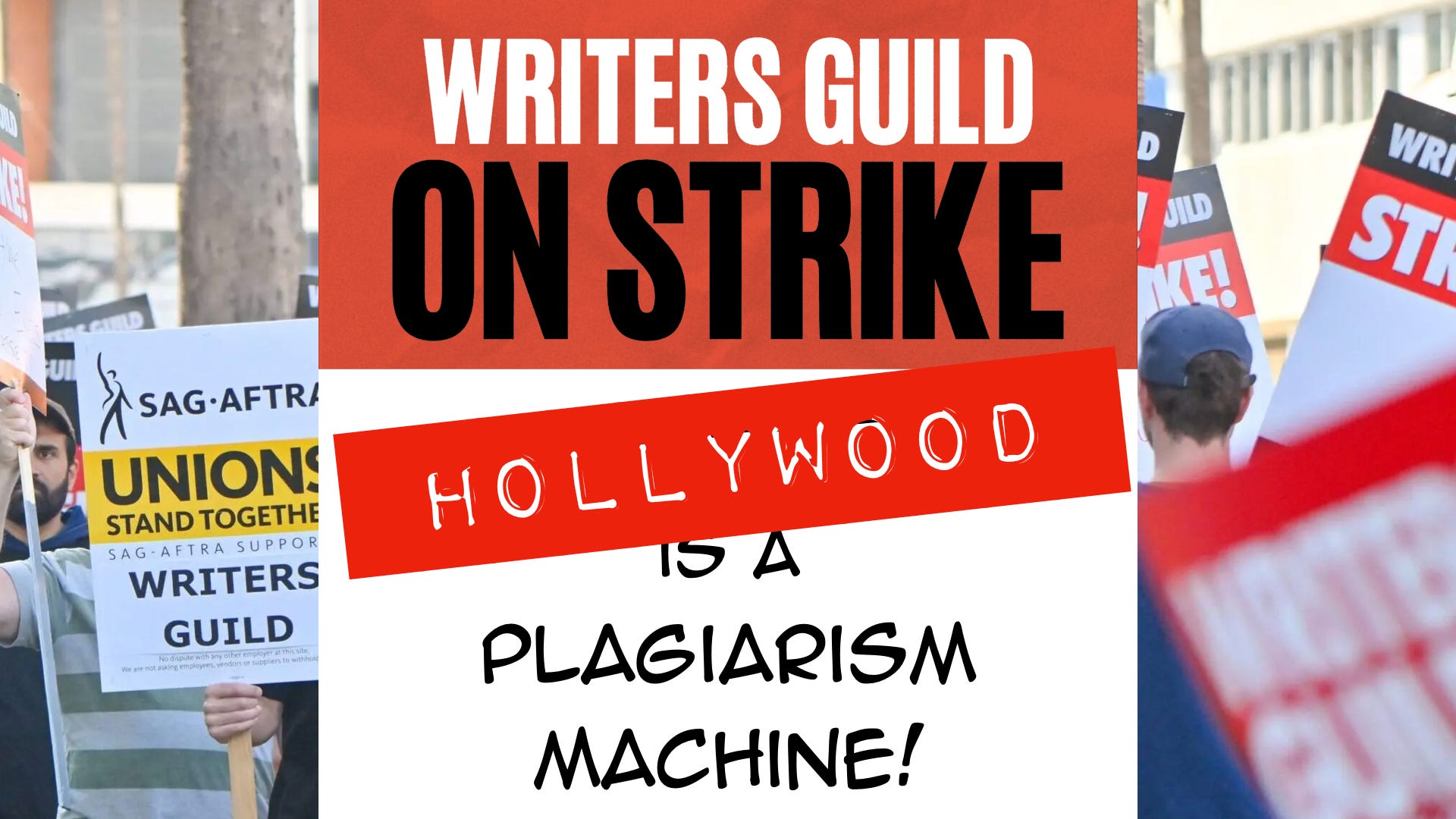
During the 2023 strikes by the creative guilds in Hollywood, I sometimes dropped by the picket lines outside Netflix and Paramount to visit friends who were walking in the noon-day heat. It was a small gesture of solidarity.
Everyone carried a sign. The writers, being writers, made theirs clever. One read: “ChatGPT Is a Plagiarism Machine.”
I laughed. Not because the sentiment was wrong but because the irony was so thick. Hollywood itself is a plagiarism machine. I said as much, out loud, on the sidewalk. The reaction was horrified. Ooops.
That remark shouldn’t be controversial. It is an accurate description of how the motion picture industry has always worked. And, I will try to persuade you here, it is precisely what makes cinema a living, evolving language rather than a static archive.
The habit of borrowing, remixing, and recycling story elements is not a bug in the system. It is the system. And generative AI is about to turbocharge it in ways that will reshape the language of film as fundamentally as sound did in 1927.
But before we get to AI, we need to reckon honestly with what Hollywood actually does.
A History of Endless Borrowing
The list of directors who have been sued for copyright infringement is not a roster of outlaws or crooks. It is, more or less, a syllabus of the most important filmmakers in cinema history with just a few exceptions.
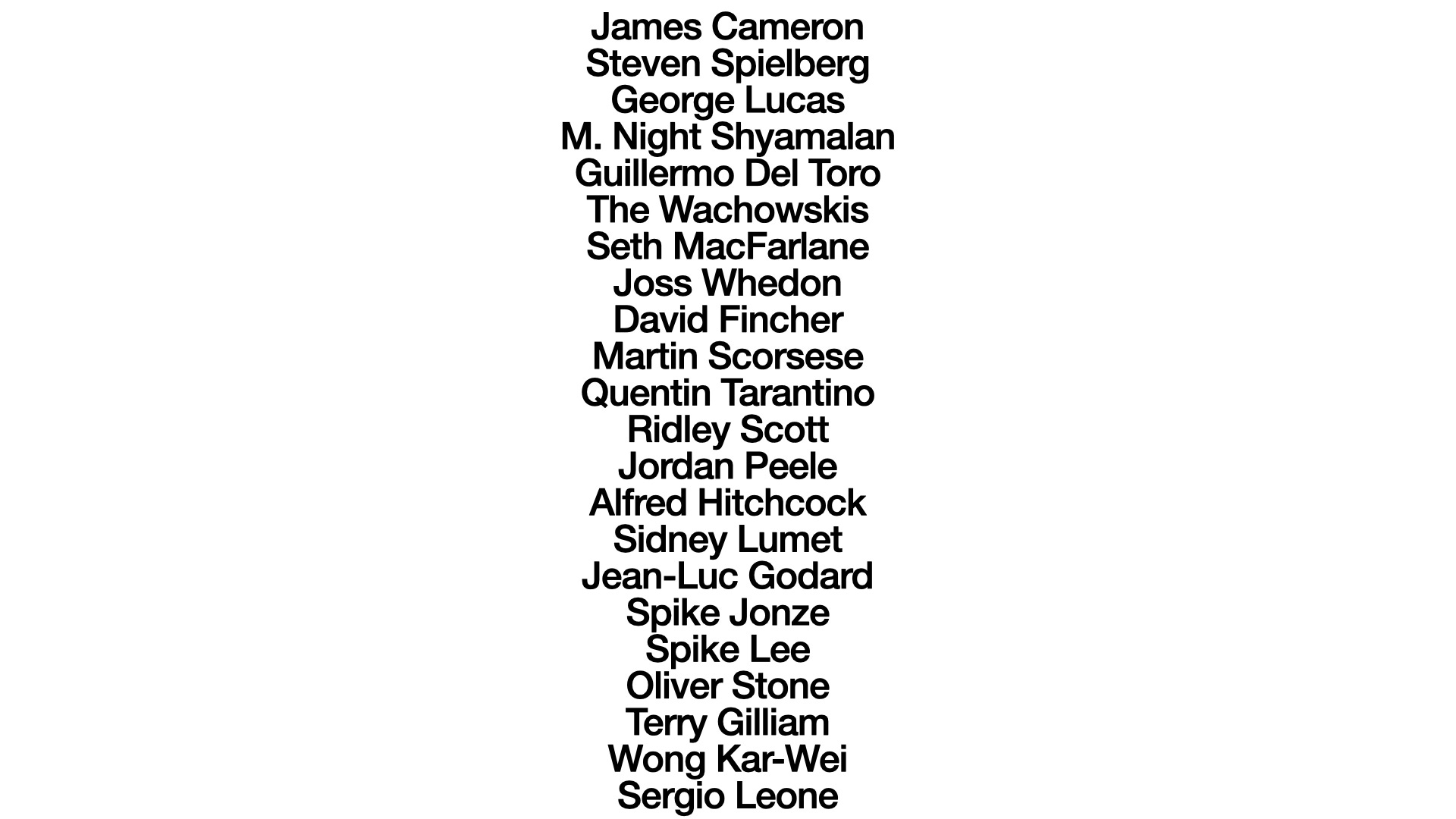
Sergio Leone’s A Fistful of Dollars (1964), the film that revived the Western and launched Clint Eastwood’s career, lifted its plot wholesale from Akira Kurosawa’s Yojimbo (1961). Leone reconstructed specific scenes almost shot for shot. Kurosawa sued, settled, and later was credited with saying that he made more money from the infringement settlement than from any of his own films. In any case, it seems that Kurosawa borrowed story elements for Yojimbo from Dashiell Hammett’s “Red Harvest”.
Steven Spielberg used Hitchcock’s dolly zoom as the centerpiece of the most memorable scene in Jaws. Spielberg didn’t just borrow the technique; he inverted its grammar. Where Hitchcock used the shot subjectively, to put the audience inside a character’s fear, Spielberg turned the camera on Roy Scheider’s face and let the distortion perform the realization for us. Same technique, opposite grammar, different emotional effect. (By the way, it’s worth noting, Hitchcock did not invent the dolly zoom in the first place. Second-unit cameraman Irmin Roberts came up with the idea for Vertigo in 1958, but Roberts was never credited for inventing the shot.)
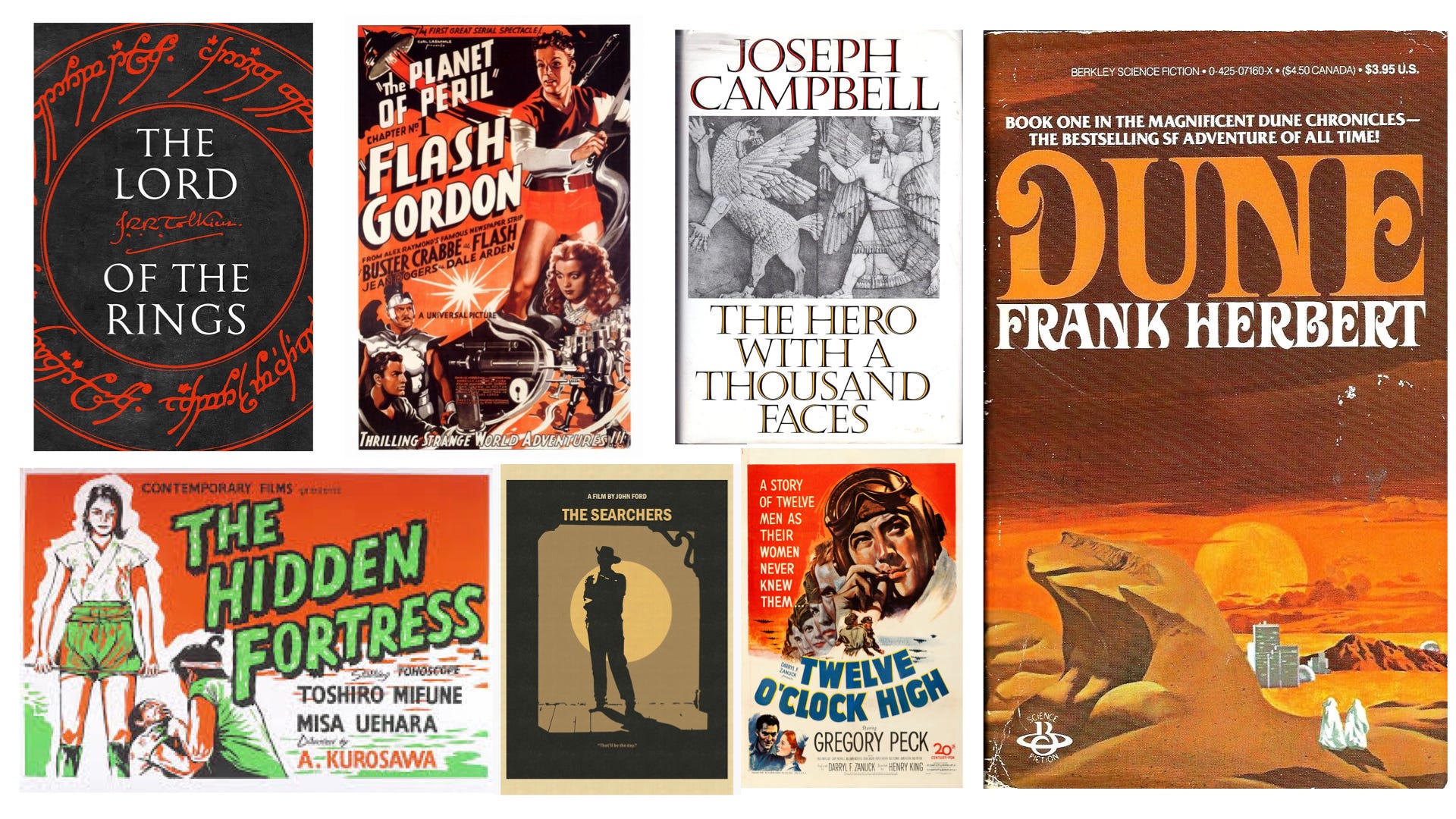
George Lucas assembled Star Wars from sources so numerous they constitute a reading list. Usually, George Herbert’s Dune gets the credit as the source for the first Star Wars film, but Herbert never sued because both stories drew from the same well of the monomyth documented by scholar Joseph Campbell (who was inspired by Carl Jung, Otto Rank, and others). The narrative engine — two bickering low-status characters escorting a princess through enemy lines — came directly from Kurosawa’s The Hidden Fortress (1958). The Death Star trench run was a near shot-for-shot reconstruction of the climactic bombing run from the 1955 British war film The Dam Busters. The wipe-cut editing transitions were borrowed from Kurosawa’s visual vocabulary. C-3PO’s design descended from the Maschinenmensch in Fritz Lang’s Metropolis. Han Solo was an archetype distilled from Western matinee movies. The word “Jedi” derived from the Japanese term for period samurai dramas.
Lucas has acknowledged all of this freely. He considers it synthesis, not theft. He is correct.
The Lion King borrowed so heavily from Osamu Tezuka’s Kimba the White Lion — a 1960s Japanese animated series about a young lion avenging his father — that Tezuka’s estate and colleagues considered legal action. Disney denied any connection. The parallels in character design, plot structure, and specific scenes remain, to this day, remarkably precise.
James Cameron’s The Terminator prompted a lawsuit from science fiction writer Harlan Ellison, who identified the film’s premise in two Outer Limits episodes he had written decades earlier. Cameron settled. The credits were quietly amended. Cameron has never publicly acknowledged the debt.
Quentin Tarantino’s Reservoir Dogs reconstructed the final standoff and several structural elements from Ringo Lam’s Hong Kong film City on Fire (1987) so precisely that a documentary was produced exclusively to display the scenes side by side. Tarantino’s response was essentially: yes, and your point is…?
These are not the exceptions. They are representative of standard practice. More copyright infringement suits have been filed against Hollywood filmmakers and studios than against all AI companies combined, a fact the industry prefers not to advertise, particularly while its members are carrying signs about plagiarism machines.
Why This Happens: The Genre Machine
The practice of borrowing is not incidental. It’s a central part of the filmmaking process. It follows from the economics of how films are marketed.
No other industry introduces dozens of products averaging $100 million in production cost, released on a monthly basis to mass audiences with only weeks to build awareness. The marketing department cannot explain each film individually to prospective viewers. The economics of media buying don’t permit that. Instead, films are sorted into genre categories: science fiction, thriller, romantic comedy, revenge story, spy film, action hero, supernatural horror, and so on.
Genre is an efficient way to telegraph what a film is about before anyone has seen it. It splits audiences instantly into those who are interested and those who are not. The job of the marketer is to make that split happen fast.
But genre is inherently parasitic on works that came before. To invoke “science fiction” is to invoke a hundred years of visual conventions, character archetypes, and narrative structures that audiences already recognize. The new film borrows credibility, expectation, and emotional cues from the genre’s accumulated history. This is borrowing by design.
The problem is that any genre reliable enough to attract audiences will eventually be beaten to death. The cycle is predictable: Genre degrades into cliché. Cliché attracts homage from younger directors who fondly recall the genre’s peak. Homage coexists with parody, which extracts whatever comedic juice remains in the exhausted conventions. Mel Brooks built an entire career on this terminal phase — Blazing Saddles, Young Frankenstein, Spaceballs, High Anxiety — performing the essential service of depleting genres so completely they could be composted.
After the parody comes pastiche.
Pastiche: The Productive Misunderstanding
Pastiche has a bad reputation it doesn’t entirely deserve. The philosopher Fredric Jameson, writing in 1984, described it as “blank parody,” a neutral mimicry of dead styles, empty of critical distance, speaking in dead languages. Unlike parody, pastiche carries no comedic or satirical payload.
For Jameson, pastiche was a symptom of cultural exhaustion, evidence that postmodern artists had run out of new things to say and could only shuffle the fragments of the past.
He wasn’t entirely wrong about the phenomenon. However, I think he was wrong about the function that pastiche serves.
Pastiche, in cinema, is not a sign of creative bankruptcy. It is a mechanism of regeneration. It converts the familiar elements of a depleted genre into new vernacular, a visual shorthand that creates an instant connection between the storyteller and the audience precisely because both parties recognize what is being quoted and understand that the quotation is in the service of something new. A scene that evokes the mood of a classic Western can communicate character, stakes, and moral geography in seconds, without exposition. The borrowed form carries meaning into the new work. This is efficiency in service of expression, not laziness.
Films like Dead Men Don’t Wear Plaid and Zelig spliced footage from old films with new material to construct entirely new stories. The Artist and Mank painstakingly recreated the filmmaking grammar of a bygone era not to fool anyone but to invoke its texture and authority. Dr. Strangelove and The Princess Bride began as genre exercises and then transcended their sources entirely, reclaiming exhausted categories for a new era.
None of this is overt plagiarism. And none of it is mere imitation, either. It is what the literary critic Linda Hutcheon called “complicitous critique” — work that acknowledges its own construction while simultaneously using that construction to say something new. The audience is not being hoodwinked. The audience is invited into a shared reference, a wink of recognition that deepens rather than replaces the experience.
Jameson feared that postmodern culture was producing a generation unable to think historically, capable only of consuming recycled images of the past. What he failed to anticipate was the filmmaker who would turn this condition into an explicit philosophy.
Tarantino and the Conscious Thief
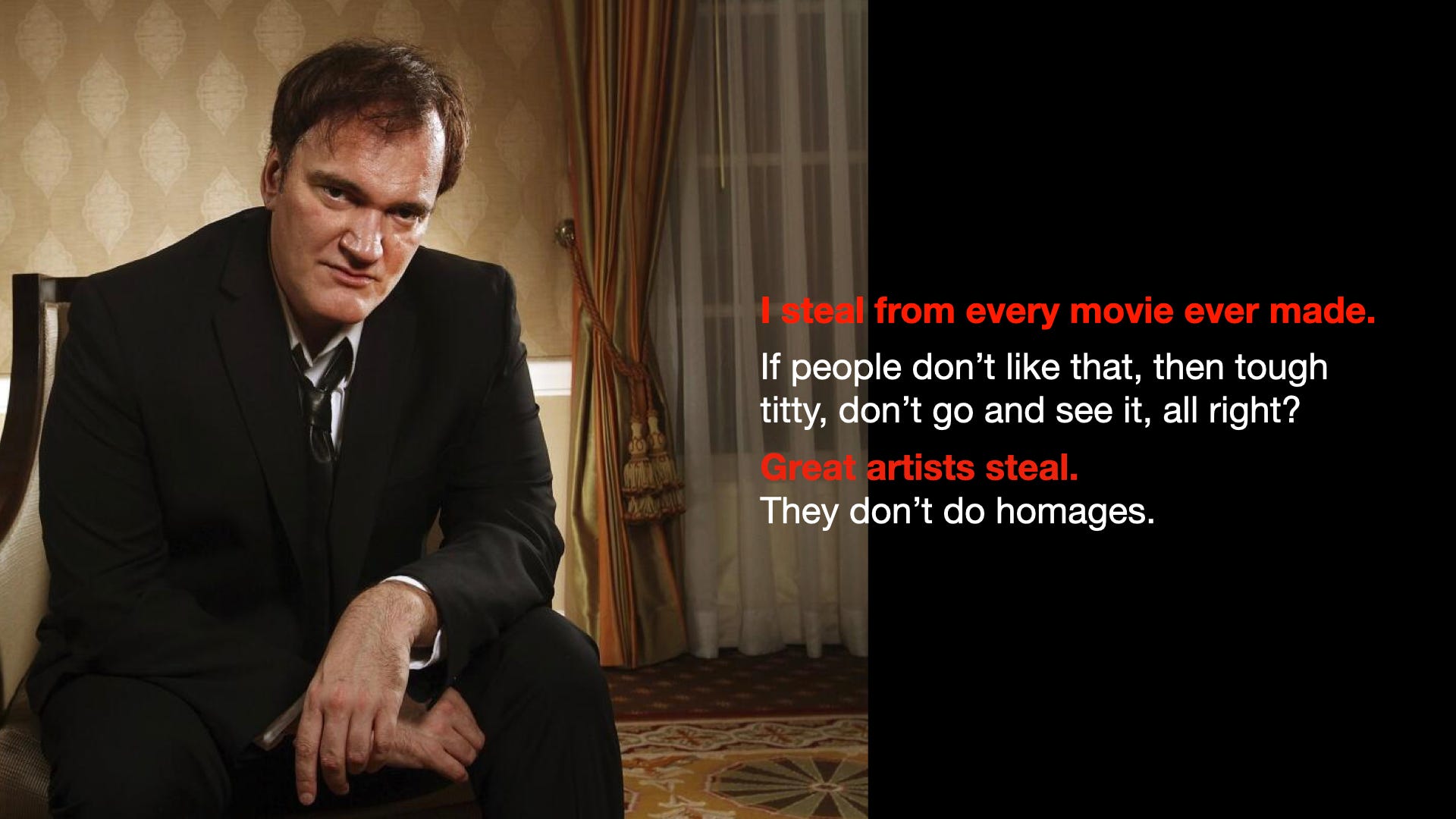
Quentin Tarantino is the figure who transformed Hollywood’s unconscious habit into a deliberate aesthetic. “I steal from every single movie ever made,” he told Empire magazine in 1994. “Great artists steal. They don’t do homages.”
That last sentence is crucial. He draws a sharp distinction between the tribute artist — who nervously points at the source, genuflecting — and the practitioner who absorbs the source, transforms it, and converts it to narrative structure. Tarantino’s borrowings are not decorative. They comprise an integral part of the story.
(By the way, Tarantino even stole that pithy remark from Pablo Picasso. Then again, Picasso may have stolen it from T.S. Eliot’s observation that “Immature poets imitate. Mature poets steal.”)
In Pulp Fiction, the mysterious briefcase comes from the 1955 noir film Kiss Me Deadly. The dance between Vincent Vega and Mia Wallace quotes both Godard’s Band of Outsiders and Fellini’s 8½ — simultaneously. The scene where Marsellus Wallace turns his head before being struck by a car is an exact recreation of a shot from Psycho. Almost none of the film’s original audience recognized any of this. It didn’t matter: the borrowed material carried emotional and tonal information that shaped their experience without their knowing where it came from.
Kill Bill is even more nakedly referential — a film that changes genre with each chapter, adopting the visual grammar and conventions of anime, samurai cinema, Italian giallo, spaghetti western, and Shaw Brothers kung fu in turn. The film doesn’t merely borrow from these sources; it becomes them sequentially, treating genre itself as a character that transforms.
What Tarantino understood, and what his many imitators missed, is that borrowing only works when the borrower understands what they are taking and why. His imitators reproduced the surface features — nonlinear structure, pop culture dialogue, stylized violence, eclectic soundtracks — without grasping the underlying intelligence. They produced what Jameson actually feared: blank imitation, noise pretending to be signal.
The distinction matters enormously for what is coming.
Reference Density and the Language of Film
There is a concept implicit in everything described above that deserves a name. Call it reference density: the degree to which a film draws on, invokes, and transforms prior works in constructing its own meaning.
High reference density is not a vice. It is, in the most successful cases, a form of compression. Every invoked reference carries emotional, narrative, and tonal information that the filmmaker does not need to establish from scratch. The audience arrives with pre-existing mental associations. The skilled storyteller exploits those associations, satisfies them, defeats them, or reframes them — any of which generates meaning more efficiently than starting from zero.
The storyteller plays the audience’s pre-conceived notions like an instrument, or perhaps like an orchestra conductor. It’s a kind of interactive engagement that demands no conscious action by the audience. Their expectations get played, and they play along.
This may be why audiences often prefer films with high reference density, even when they cannot articulate exactly why they like them. They recognize something. The recognition creates a bond between viewer and filmmaker, a confirmation of shared cultural vocabulary. Film genres exist in part because audiences want this confirmation.
Reference density is, to steal from the language of computer science, a form of recursion — the ability to pack more information into a statement by reference to prior statements, rather than restating everything from first principles. Linguists consider recursion a defining feature of human language. Cinema developed its own recursive grammar over a century of accumulated practice.
The Simulacrum We Already Inhabit
Before we address what AI adds to this, it is worth registering something that Jameson did not live to see completed, though he sensed it coming.
Jameson wrote that postmodern culture risked producing an age that “had forgotten how to think historically” — that the recycling of representations would eventually replace the representations themselves, leaving audiences with access to the past only as a collection of stylistic connotations, not as a record of lived experience. Jean Baudrillard went further: the map precedes the territory. The simulation becomes more vivid, more compelling, and more real than the reality it was built to represent.
They were describing a tendency. We are living inside the simulacrum. The smartphone in the pocket of every person in the restaurant has been engineered at extraordinary expense and effort to be more stimulating than the people at the table. The algorithm has optimized its content to outcompete unmediated experience for human attention. We carry a simulacrum-generating device and consult it hundreds of times per day. This is not metaphor. This is the operating condition of contemporary life for billions of people.
What neither Jameson nor Baudrillard fully anticipated was the recursive twist: we are not merely consumers of the simulacrum. We are its continuous co-authors. Every click, scroll, share, and search query updates the model that determines what we see next. The simulation learns from our responses to previous simulations. We learn from the simulation. The boundary between the map and the territory does not merely blur — it becomes a feedback loop optimizing for engagement rather than meaning.
Cinema trained audiences to read images. The attention economy now trains audiences to respond to images in ways that sustain the attention economy. This is Jameson’s dead language automated and industrialized at scale, running on human behavioral data as its training corpus.
And into this environment arrives generative AI.
AI + Human Authorship will retrieve remixing
When I began this series of articles, I cited Marshall McLuhan’s Tetrad of Media Effects as a framework for understanding new technologies by posing four questions. One of McLuhan’s four questions is: what practice does the new medium retrieve from the past that had previously been abandoned or marginalized?
For generative AI in cinema, the answer is clear: it retrieves and accelerates the grand tradition of remixing, creative reuse, and reference-dense storytelling that Hollywood has always practiced but never fully acknowledged.
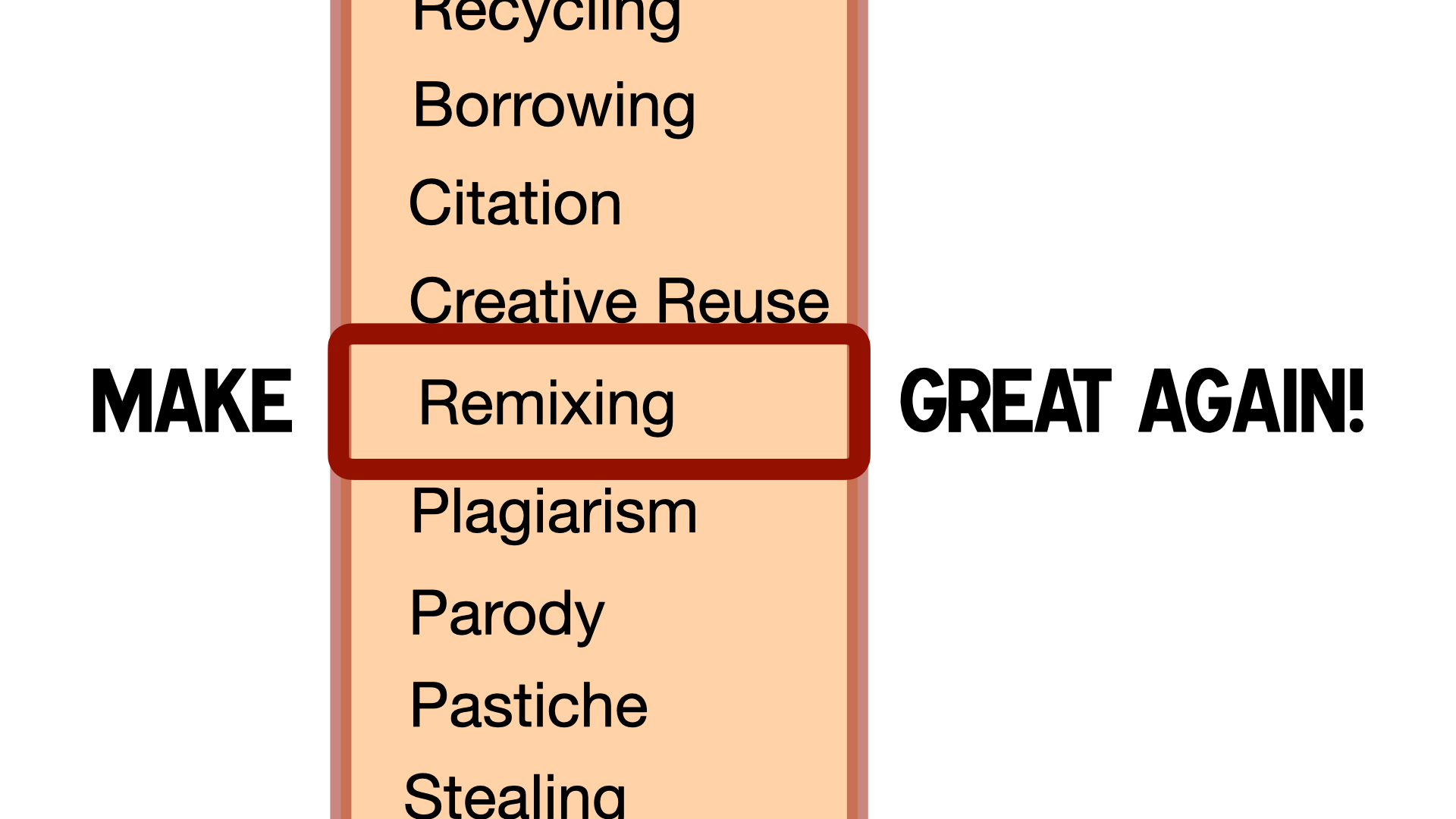
Generative AI is, at its core, a pattern-completion engine trained on the accumulated archive of human cultural production. Its outputs are, by definition, recombinations of what it has ingested. In this sense, GenAI is the ultimate pastiche machine. The critics who say this as a condemnation may be surprised to discover that they are describing it accurately and evaluating it incorrectly.
The question is not whether AI recombines prior work. It does. So does every filmmaker on the list above. The question is whether it does so with understanding, intention, and the kind of transformative synthesis that generates new meaning from borrowed material — or whether it produces the blank mimicry that Jameson rightly criticized.
The honest answer, today, is: mostly the latter, with glimpses of the former. Fully automated AI video is, at this stage, formulaic, often illogical, and emotionally flat. This is a fundamental limitation of training on patterns rather than experience. The system has ingested the archive without living through it. It can reproduce the grammar without understanding what the grammar is for.
But that is a call for human authorship. This is precisely where the human-AI collaboration model becomes decisive. The breakthrough is not AI replacing human creative judgment. The breakthrough is AI executing human creative judgment at a scale and speed previously impossible from a much broader palette of references than any one human can recall. The intention, the selection, the iteration, the understanding of what is being quoted and why: all of these remain irreducibly human. What changes is the cost and ease of execution.
A small team with genuine creative vision can now achieve what once required studio resources. Reference density that previously required years of film school and a lifetime of obsessive watching to deploy can now be accessed, layered, and refined in the production process itself.
The directorial intelligence that Tarantino applied to his archive, his unmatched ability to reach into cinema’s history and retrieve exactly the right image, scene, or convention for a given narrative purpose, will become a capability that can be utilized beyond the handful of filmmakers who have spent their lives in video stores.
The Copyright Contradiction
The Writers Guild member carrying the “ChatGPT Is a Plagiarism Machine” sign was, in a pedantic technical sense, wrong twice over.
First, copyright law has nothing to do with plagiarism. Copyright protects specific expression; but plagiarism pertains to ideas and attribution. They are governed by different bodies of law and different ethical norms. Confusing them is a category error. One cannot copyright an idea, a fact, a technique, or a style.
Second, and more pointedly: the practice of creative reuse, remixing, and building on prior work that AI is accused of conducting is indistinguishable, in its basic mechanics, from what every filmmaker on the list above has done throughout the history of cinema. The outrage is selective in a way that serves incumbent interests rather than any principle.
This is not to dismiss the legitimate concerns about AI and copyright. There are genuine legal questions, currently being litigated in roughly 100 active U.S. cases, about whether training AI models on copyrighted material constitutes infringement. These questions deserve careful adjudication. The courts will work through them.
What should not be permitted to stand unchallenged is the claim, made with righteous indignation by an industry that has been merrily strip-mining the creative commons for a century, that creative reuse is inherently unethical, nor that building on or citing prior work is morally equivalent to theft, not that any technology that facilitates such reuse is therefore malign.
Copyright law exists, according to the U.S. Constitution, not to protect authors but to benefit society by fostering the useful arts and sciences. The fair use doctrine, which permits quotation, parody, commentary, and transformative use, is what makes copyright law constitutionally compatible with First Amendment protections.
Without fair use, copyright would be a censorship mechanism. Copyright maximalists have spent fifty years trying to achieve exactly that outcome, by extending terms, expanding scope, and suppressing public awareness of the public’s own rights.
Generative AI, by democratizing the tools of creative reuse, may do more to restore the balance between authors’ rights and the public interest than any legislative reform in recent memory. That is an outcome the incumbent industry correctly perceives as a threat — not to artists, but to the business model of extraction that has been built around controlling the archive.
The Forecast
Here is what I expect to happen, stated plainly.
Generative AI will retrieve and accelerate the tradition of remixing and creative reuse in cinematic narrative. It will do so not by replacing human creative intelligence but by dramatically lowering the cost of executing it. Small teams with genuine vision will be able to produce work of a sophistication and reference density that previously required studio resources. The gap between having something to say and being able to say it cinematically will narrow.
The cycle of genre evolution — from fresh convention to cliché to homage to parody to pastiche — will compress. What previously took decades will occur within individual films, perhaps within individual scenes. Skilled directors will stack references into single shots: blends of homage, citation, parody, and formal innovation that communicate with an efficiency the medium has never achieved.
The audience will participate more actively in this process. As AI tools become accessible to viewers, the practice of remixing and reinterpreting cinematic material will move beyond the production studio and into the community of reception. This is not the death of authorship. It is the extension of authorial intelligence outward, creating a feedback loop between storytellers and their audiences that the medium has never previously permitted.
The industry players that fight this process, meaning those who attempt to use copyright law as a weapon against creative reuse and AI-assisted production, will find themselves in the position of the labels that fought digital distribution in the 1990s, or the studios that fought television in the 1950s. They will spend enormous resources on a rearguard action to preserve a crumbling business model and will thereby miss the chance to define the future while winning occasional legal battles and extracting a tiny licensing revenue stream.
Hollywood has always been a plagiarism machine. The writers on the picket line were right about that, even if they aimed their observation in the wrong direction. The question is not whether to borrow from the archive. The question is whether to do so with the intelligence, intention, and transformative ambition of a Kurosawa, a Leone, a Lucas, a Tarantino — or to mindlessly crank out the blank mimicry that Jameson rightly condemned.
That choice remains, as it has always been, irreducibly human.
###
About the author: for 30 years, Robert Tercek has worked at the bleeding edge of media innovation. In more than 30 nations, he led the design and launch of breakthrough digital services that today are enjoyed by hundreds of millions of people, including the world’s first streaming video to mobile devices, the first large-scale multiplayer games on the Web, and the first multi-channel television in Asia. He is the host of The Futurists podcast and is frequently invited to share his perspectives on innovation at industry conferences and corporate events.
I never stole a joke I didn’t like. -Milton Berle
Spot on, Rob. Well done -