

In this edition of the Owner’s Guide to the Future, I offer the first in a series of forecasts about how generative artificial intelligence will change storytelling in the motion picture industry.
Last week, I published an article that described what I set out to accomplish in this series. I wrote that the best tool I know of when it comes to formulating a hypothesis about the future of media is Marshall McLuhan’s Tetrad of Media Effects.
McLuhan observed that every new medium exerts not one but four simultaneous effects on existing observable trends.
He presented the Tetrad as four questions:
What current trend will the new medium render obsolete?
What outmoded trend will the new medium retrieve and revive?
What current trend does the new medium enhance or intensify?
When pushed to an extreme, what current trend will be reversed by the new medium?
Today’s article addresses the first question: what current trend will generative AI render obsolete?
My short answer is: GenAI will make the trend towards ever-bigger films crew obsolete.
My longer answer is that GenAI will introduce a completely new workflow that renders the entire 20th-century filmmaking process obsolete.
The current trend of hiring ever-more animators and VFX specialists in post-production will soon be unnecessary. Post-production has been the area of most rapid hiring growth for years. But the continued expansion of crews will come to an end. Eventually GenAI will make it possible to replace the most of the film crew, and the actors, too.
What makes me so confident? The fact that 20th century methods are already obsolete, independent of AI. Costs are skyrocketing, crew sizes continue to expand, and productivity is lagging as the majority of the industry clings to outdated methods. This is unsustainable. GenAI tooling and workflows will simply accelerate the path towards obsolescence.
Today, the motion picture industry stands indecisively at a crossroads.
Along one path is the old, tried-and-true method of making a film. Eventually AI tools will be folded into this old method, incrementally and peripherally, in non mission-critical tasks. This is the path of Sustaining Innovation: doing the bare minimum innovation to eke out more profit and preserve the old way of making a film while shaving a few dollars off a bloated budget. As any student of Clay Christiansen knows, sustaining innovation leaves incumbent companies exposed to disruption.
On the other path lies a much leaner and faster method, but it requires a complete retooling the workflow and upskilling of the workforce. This is the path of disruption. It’s hard. Candidly, the AI tools are not quite reliable or stable enough to make this transition easy. Soon, they will be better.
The majority of professionals working in motion pictures today are skeptical about AI because it seems more like a threat to their career than a solution to a problem. Especially because the “problem” that AI solves in the film industry is the high salaries they are paid. For these reasons, it is difficult for them to choose this second path. That leaves a lane wide open to disruptors.
When mature, GenAI tooling will support an entirely new workflow that will obviate the outdated production methodology that hangs over from the previous century. Then the entire movie and TV industry will scramble to adopt the new non-linear workflow. By that point, it may be too late for incumbents to adapt and survive.
Within three years, GenAI will make it possible to produce an entire TV series on a computer, without a human cast or crew, and without filmmaking equipment like cameras, lights, dollies and C-stands, and without a sound stage, or a set, or physical props.
Some people are already attempting to produce scripted series with the current AI tools today. These are the disruptors, but their work is cumbersome today. That’s why it remains out of reach for most people. But that’s not a permanent obstacle, it’s a target. Many dozens of startup companies are focused on streamlining the GenAI process so that anyone can generate a film from their desktop. Some of them will succeed. Then there will be millions of people who can create motion pictures.
At the current pace of improvement, within three years the perceived quality of the output from AI will match the output of a digital camera filming live action on a sound stage with human actors and a hard set. The output of generative AI systems for cinema will be indistinguishable from film or video captured in camera.
That is why I believe it will be possible within three years to produce a TV-quality scripted series entirely with generative AI, with no human cast and no live production. For animation, I expect this will occur even sooner. And the cost of production will be 90% lower than the current method, and several times faster.
This is not a question of if, but when.
When the first wave of ultra-low-budget films produced this way begins to capture audience attention, the old-fashioned process of making a feature film will be revealed as obsolete.
That’s it. That’s the forecast.
I know some readers prefer to dig into the details. Read on.
The current filmmaking process is outmoded and ripe for disruption.
Modern motion picture production is based on the outdated industrial model of the assembly line. It’s a hangover from 100 years ago.
Back in the 1920s, Fordism and Taylorism were all the rage. Henry Ford’s assembly line was a novel idea in those days. People considered him a manufacturing genius and sought to replicate his success in every sort of industry.
The tight-fisted moguls like Adolph Zukor who ran the first movie studios were keen to get the most for their money. Zukor needed a standardized process to produce films like clockwork, delivered on a predictable basis, to fill the theater chains he was busy buying for Paramount.
Zukor also liked the way the assembly line deskilled work, turning high skill jobs into easy-to-learn tasks. That made individual workers replaceable. This suited his objective of reducing the bargaining power of film crews just at the moment when labor was getting organized.
That’s why Hollywood adopted the auto industry’s assembly-line process.
Leading the charge was producer Thomas Ince. He demonstrated that film production could be scaled with the assembly line method to crank out cookie-cutter pictures. By the 1930s, after the Great Depression had taken a big bite out of box office revenue, Ince’s approach was adopted by all studios to crank out movies on low budgets, but he wasn’t around to see it because he had died under mysterious circumstances in 1924.
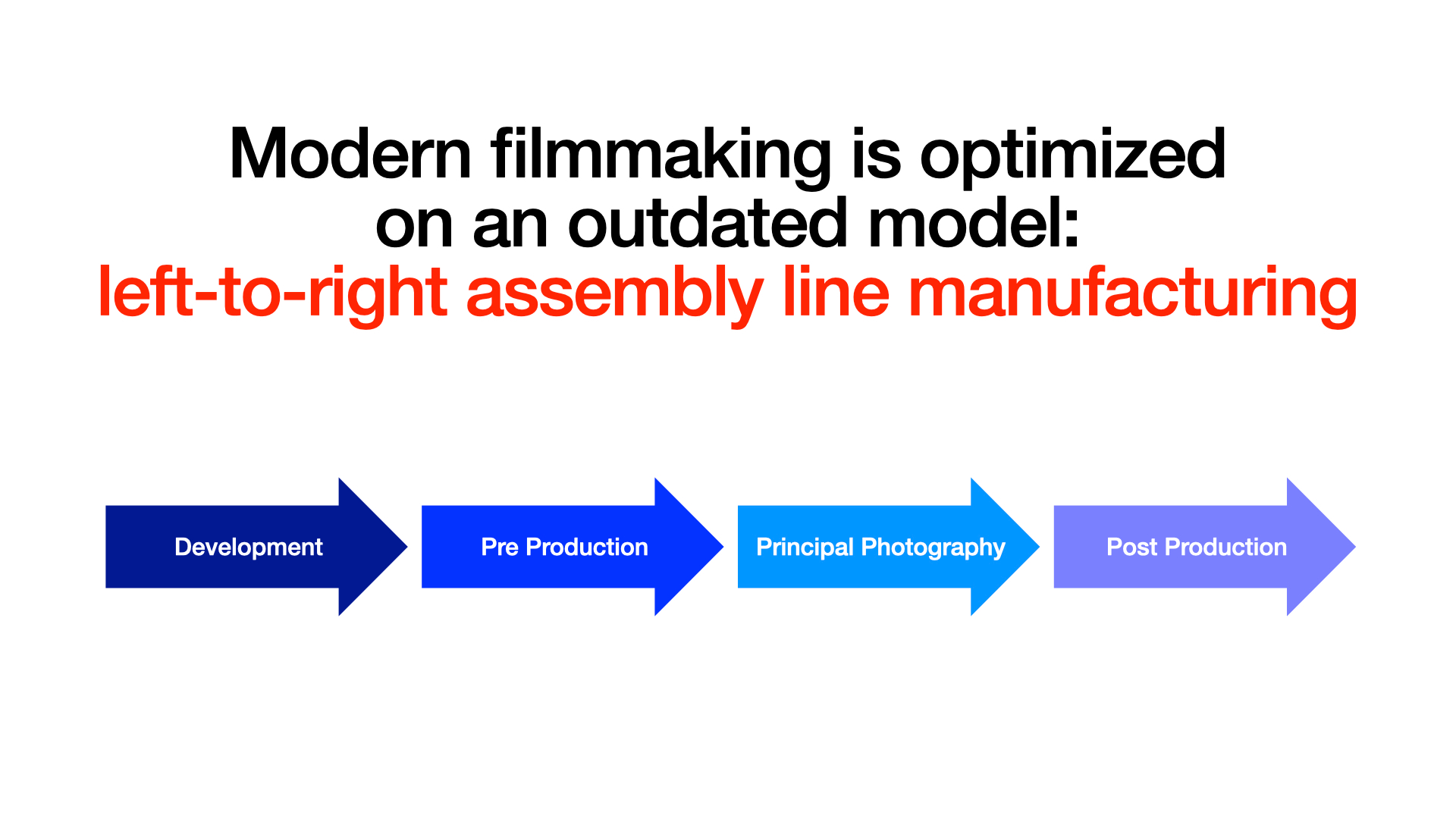
Ince’s production method lives on today: Every task in filmmaking is sorted into discrete stages managed by specialists. Today these tasks are grouped into the four stages of film production:
Concept development and screenwriting;
Pre-production planning, budgeting, scheduling, and pre-visualization design;
Principle photography / production;
Post-production comprising picture and sound editing, color correction, sound design and scoring, sweetening, mixing, looping, sound effects as well as visual effects or computer-generated imagery.
Three things to notice about this production process: it happens in a strictly linear, left-to-right sequence; the workers are classified and confined to specific, clearly-defined roles in each stage; the entire project is managed by a hierarchy, with the critical creative decisions made by a small number of people. Everyone else is just an order-taker.
This combination of linear sequence, defined roles, and hierarchical decision-making mean that the creative scope of the project grows narrower at each stage of the process. There are fewer creative decisions to make as the film project moves from left to right, that is, from screenplay all the way through to the post-production process.
In the past, these three constraints helped to make film production efficient; but that is no longer true today. That’s one big reason why this methodology is outmoded.
What makes it work is also what makes it deeply flawed: the creative potential of 99% of the crew is squandered. How? In the early stages, a multitude of creative decisions are made, approved and locked; when that is done, the entire project passes to the workers in the next stage of production, who implement what has already been decided, and within those constraints, make further creative decisions which are, in turn, approved and locked; then the project is chucked over the fence to the workers in the next stage to carry out instructions, and so on, until completion.
At each stage, the range of creative decision-making grows narrower and narrower until the workers in the final stage have creative purview over only their small segment of the film. Everything they do must conform to what has been decided by others much earlier in the process.
This linear, left-to-right process is so well established that it is difficult to imagine another way to do it. But GenAI will make another approach possible, probably inevitable. Read on.
Why the 20th-century production model is outmoded.
There are some big problems with the old-school assembly-line approach to making a movie today:
Little automation. Filmmaking remains a labor-intensive process. Few of the steps in the process are even partially automated. No step is fully automated.
Key creative decisions are locked too early. It is very difficult and expensive to make major changes in the later stages of production. This is an arbitrary constraint.
The group with the most visibility into the final product has too little agency to make major creative changes that might save a flawed film. Today the fastest-growing part of any film crew are the people work in post-production, where creative agency is most constrained at the end of the line. These are the first people who get to see the film as a whole, and they are the least-empowered to do anything about it.
Most pernicious of all, the total number of people working on the crew continues to rise despite the studios’s efforts to contain costs. Which means the assembly-line approach is utterly failing to accomplish the main goal set out by Tom Ince 100 years ago. I recommend reading Stephen Follow’s excellent analysis of the top-grossing 200 films from the past decade to see just how dire this problem is.
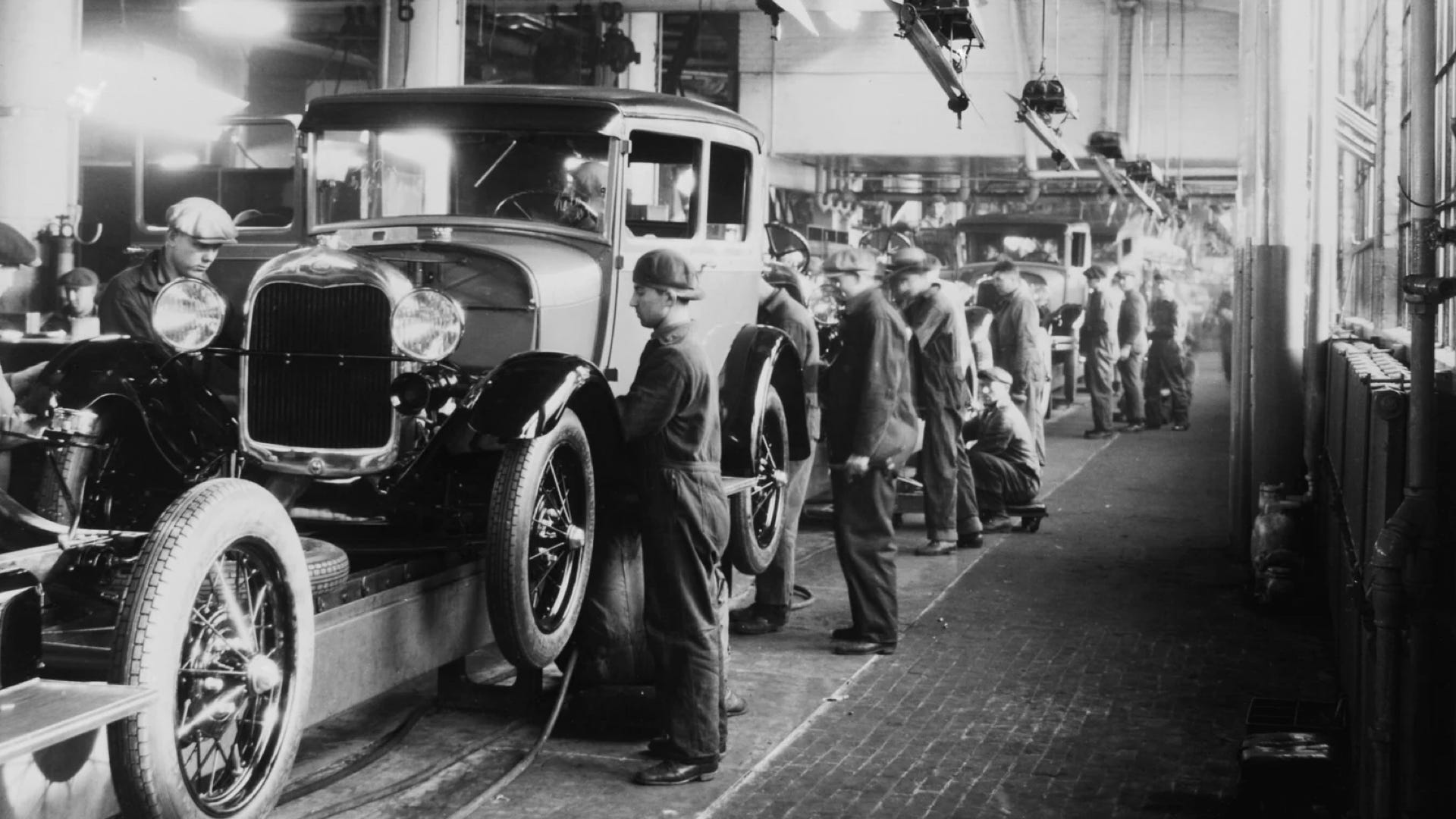
Let’s illustrate the point. This is what an automobile body plant looked like 100 years ago:
And this is what an automobile body plant looks like today:
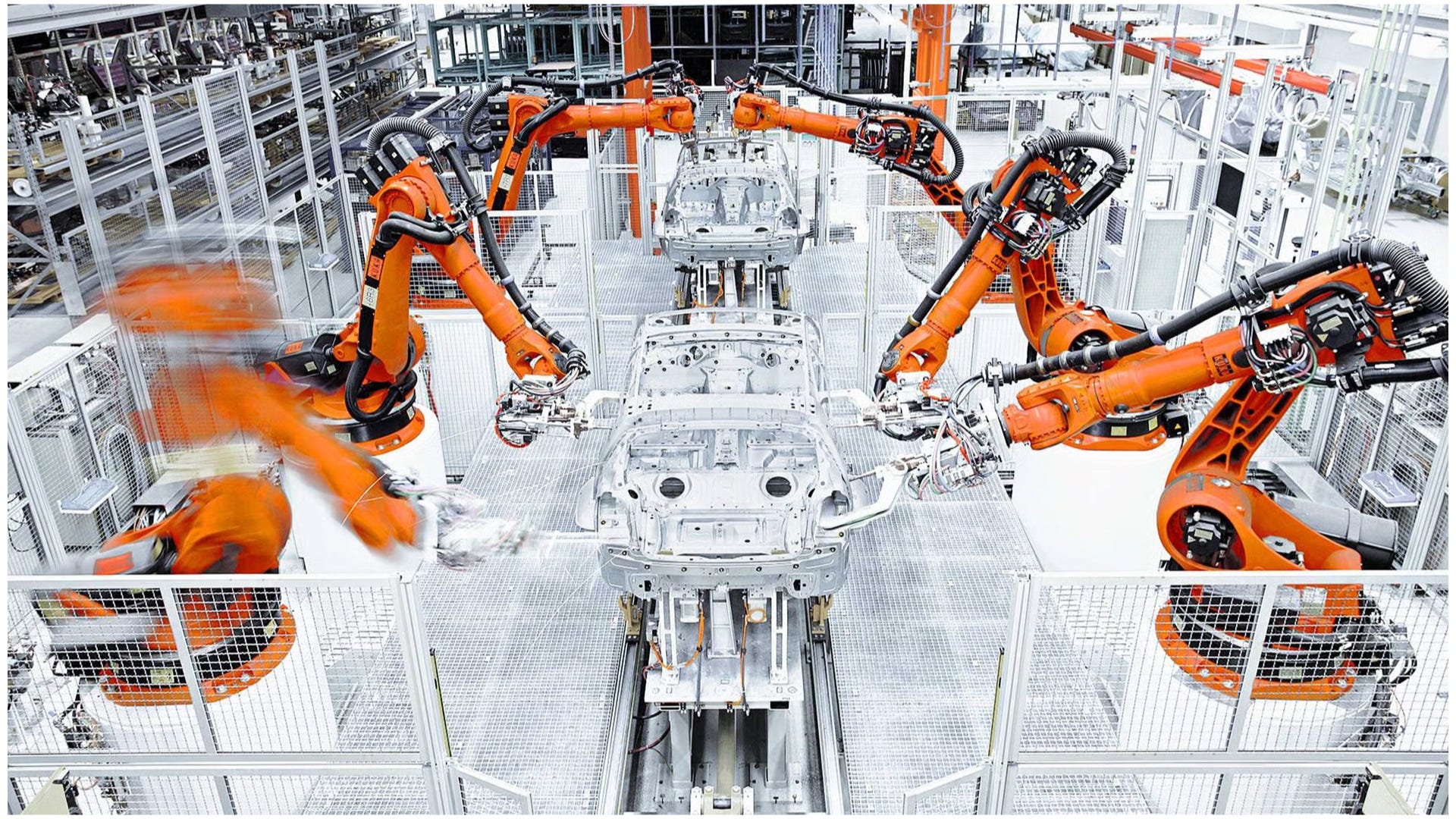
Notice that there are no human workers in today’s auto body plant. Just robots, moving so quickly they are a blurred in the photo. The robots are dangerous to human workers, which is why there are metal cages built around the assembly line. Not to keep the robots in, but to keep the humans out of harm’s way. This is true of every auto body plant in the world.
Of course, there are still plenty of human workers employed elsewhere, such as in the finishing plant, where upholstery and electronics are installed. But the factory where bare metal is welded to a chassis is entirely automated. This is a remarkable feat of engineering, and one big reason why the cost of new automobiles has remained affordable in spite of rising costs for materials and labor.
The 125-year history of auto manufacturing can be summarized as: first, bespoke auto construction was replaced by standardization and Ford’s assembly line. Then further automation steadily reduced the number of human jobs; today where there are no human workers in the body plant. Next: Full automation.
Now let’s compare the auto factory to film production.
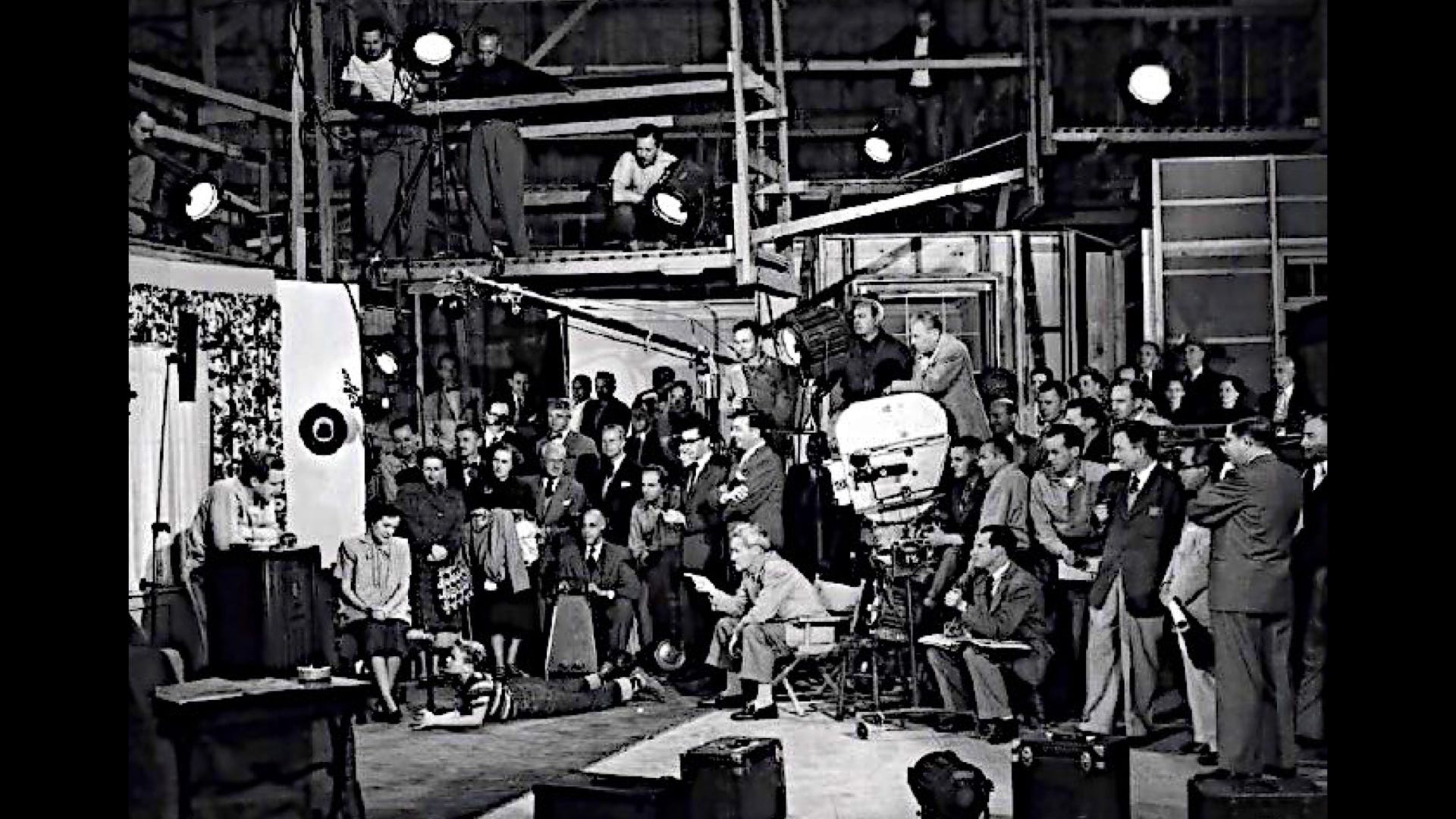
Here’s a photo of a motion picture set taken in a sound stage 100 years ago:
And here’s a motion picture set today:
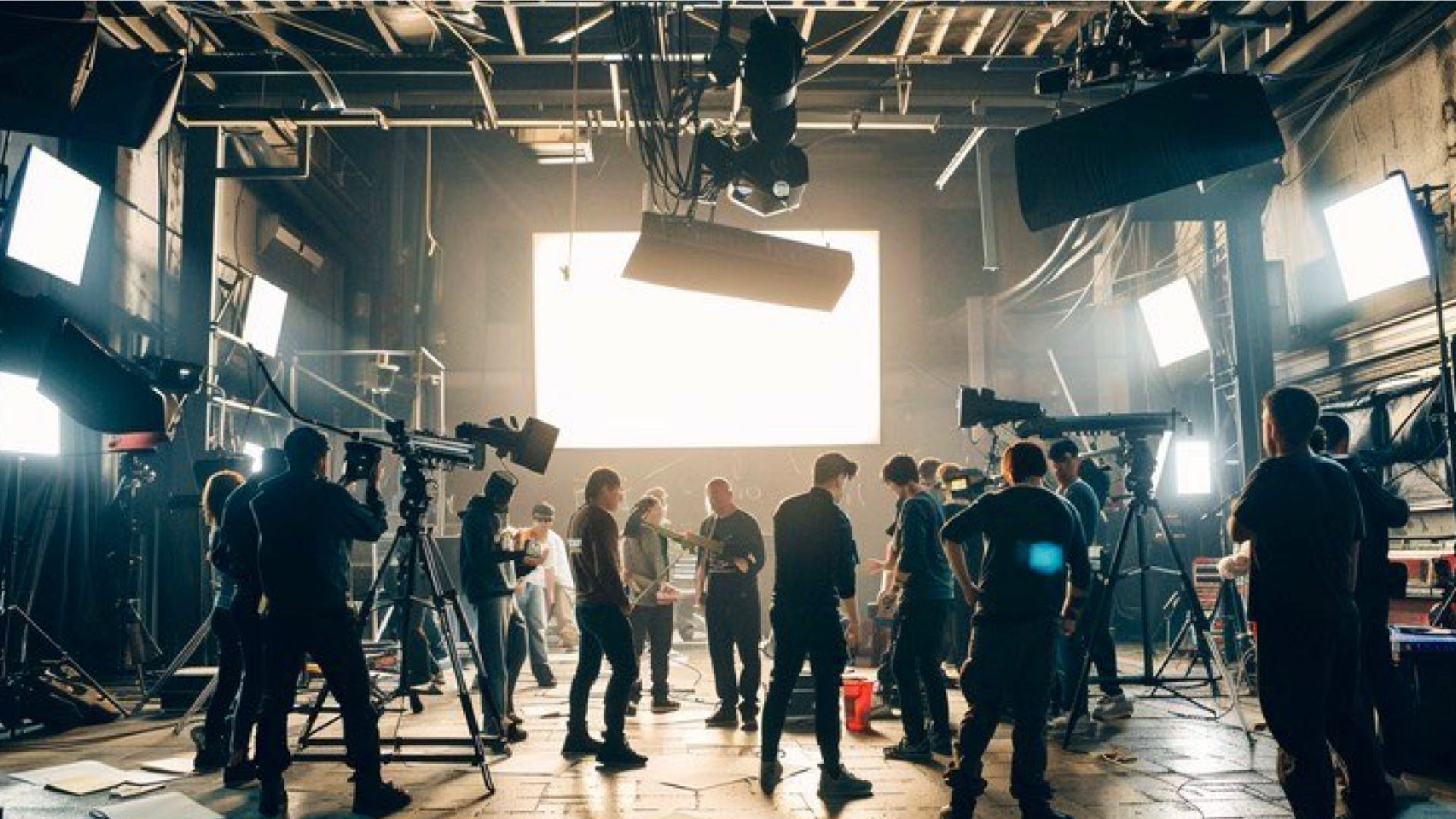
Unlike an auto factory, there are lots of human workers on the film set today. No robots in sight. Hardly any automation except for motion control camera rigs. The only visible difference from 1920 is that the human workers are wearing black t-shirts instead of suits and ties.
What is not shown is the fact that the total number of workers on a film continues to rise. That’s because the largest number of crew is not found on the set, but in a post-production studio or an edit bay.
This metric is moving in the wrong direction. Since 1997, the average number of crew on a top-200 feature film has risen by more than 70%. Which is one big reason why motion picture budgets continue to balloon despite enormous pressure.
However, in the same 25-year time period, box office ticket sales are down 47%, while the rate of cord-cutting from PayTV is accelerating, while broadcast TV audiences and revenue continue to plummet.
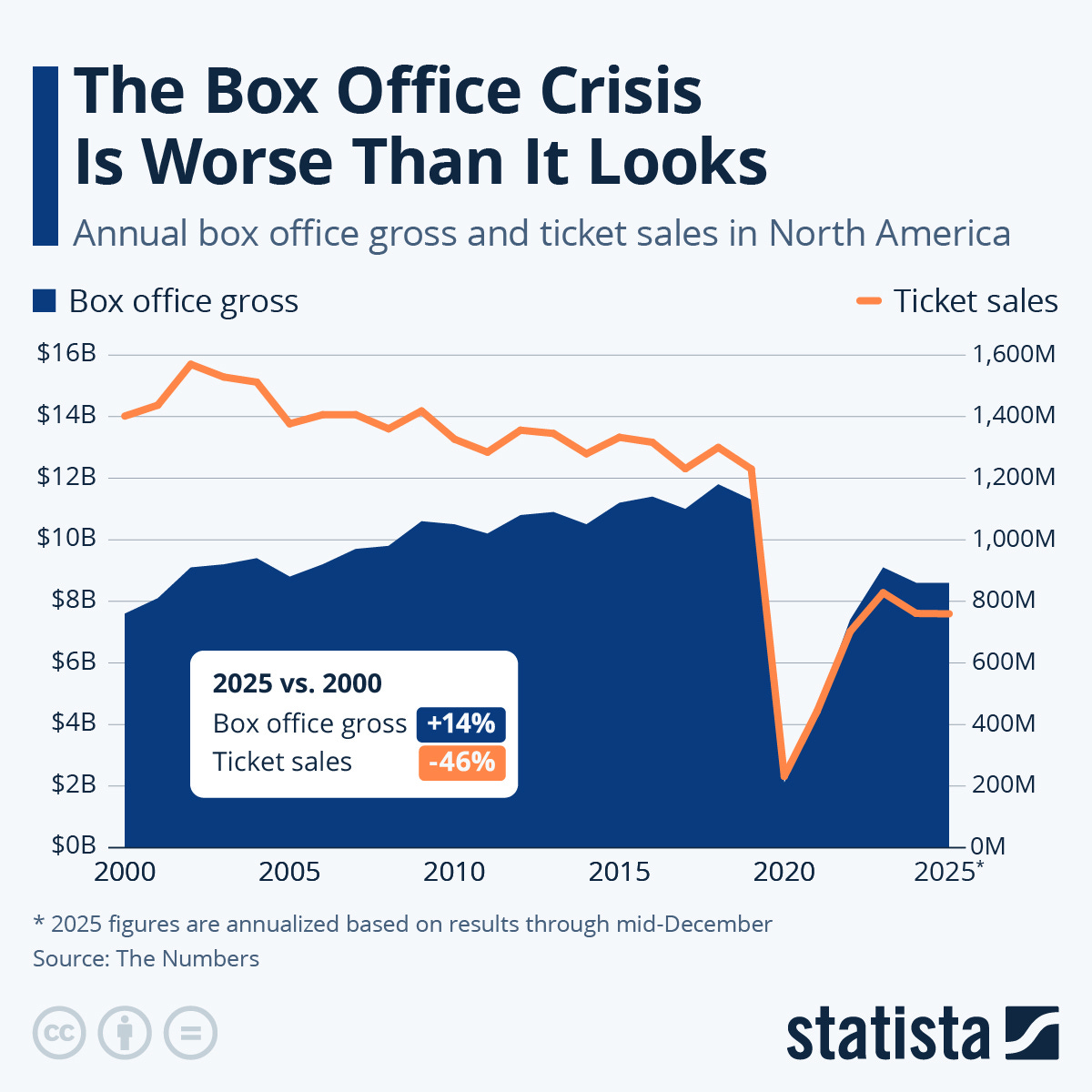
When labor cost is rising and revenue is falling, what time is it? Clearly, it is time for a new method of production.
This is why generative AI is inevitable in motion picture production. GenAI promises to reduce the cost and time for making a movie or TV show by 90% or better.
The Assembly Line Stifles Creativity
To me, the bloated film crews hide an even bigger issue: it’s a waste of money.
One consequence of the rigid left-to-right nature of the assembly line is that the people in the very beginning of the process make a huge number of decisions that cannot be undone, even if people who participate later in the process can see clearly that the result of those decisions will lead to a train wreck.
Which means the ever-greater spending on hiring more professional creative talent is mostly wasted.
Why? In part, it is due to Hollywood’s caste system, where above-the-line profit participants enjoy a near-monopoly on the creative decision-making during the early phases of the production. After principal photography is wrapped, most of the elite folks exit while the below-the-line caste continues toiling, following instructions without the freedom to make meaningful creative changes.
The key players (above-the-line talent) are together on a film project for only a short time before they disperse to new projects. The assumption is that the best time to make key creative decisions is when the key players are together. In theory, this is efficient. In practice, it locks the production into a straitjacket.
The assembly line combined with Hollywood’s caste system prevents downstream players from revising the decisions made upstream. This means that the defects in a film or TV production tend to accumulate as it moves, left to right, through the linear process.
Sometimes, the producers realize late in the process that they need to make a change. On rare occasions, they are obliged to call the cast back because a certain sequence must be re-shot. This is incredibly expensive. Sometimes it is impossible because the actors are already committed to perform in a different production. Re-shooting a scene rarely happens.
What never happens is that an editor says, “Sheesh, this film is a turkey. Let’s rewrite it.” They may very well think that, but editors are not empowered to do much about it.
The director often has the right to approve the editor’s final cut, but the editor does not enjoy any reciprocal right to approve the footage shot by the director.
(Occasionally, the editor is invited to the set during the shoot. Then the director might deign to take some advice from the editor’s perspective, but this is rare.)
Everything described in the previous five paragraphs represents a net loss of the increasing investment in creative intellect. Some the most creative people happen to be involved in the final stages of editing and scoring the film, but there is very little room in the process for their creative input. They are also the first to see the entire film as a whole, but the system prevents them from exercising creative judgement over the locked parts of the project.
Long before the final cut, the folks in the edit bay can see what is working and what isn’t; they can imagine artistic ways to improve the parts that sag, or don’t make sense, or are just plain bad. But the system will not allow them to do so. Editors are not permitted to rewrite a boring scene or tweak an actress’s facial expression, let alone replace an entire character or add a new character or scene.
This problem is getting worse because the number of creative professionals at the tail end of the process is rising, not falling. This is a wasted investment. The greatest increase in film jobs today is in post-production, mainly in VFX. Paradoxically, this is also the group that is least empowered to make a significant creative change to the story or to the performances. The primary responsibility of a post-production crew member is to follow instructions for the scene they’ve been hired to animate.
In other words, the studios are spending more to hire more people, and confining them to roles where they have the least creative input.
Hollywood is investing ever more into a growing pool of human labor but getting ever-smaller creative ROI.
GenAI will reverse this trend.
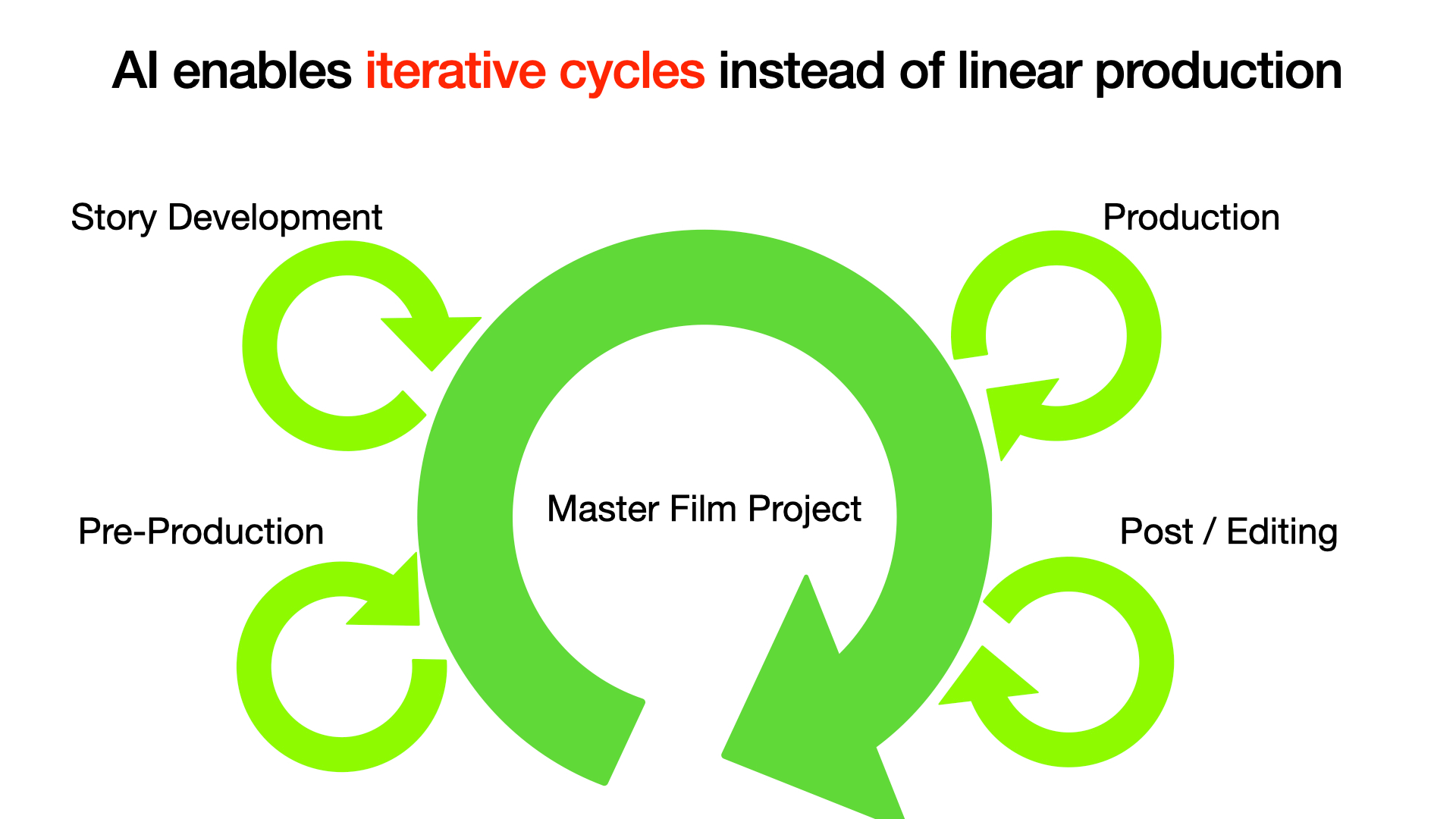
How GenAI’s iterative creative cycle will transform cinematic storytelling
With GenAI, there is no “final cut”. Scenes can be endlessly regenerated. As the AI video models improve, a film produced last year can be re-generated with better visuals next year. Call it a “living film” with no need for a final cut.
With GenAI, the number of creative options expands as the production proceeds. This is a complete reversal of the 20th century process. With GenAI, it’s easy and quick to generate multiple versions of the same shot, or even an entire sequence of shots. Endless variations on a particular shot (or prop, or wardrobe item, or any other element) can be iterated and tested.
To make the contrast clear: in traditional left-to-right assembly line film production, the cone of creative possibility narrows at each stage. But with GenAI it is just the opposite: the cone of possibility expands at every stage.
The Immense Value Unlocked With Non-Destructive Workflows
The iterative, non-linear approach is a unique affordance provided by generative AI. This is about to get a major turbo boost.
Today, GenAI is a destructive process. Here’s what “destructive” means: if you don’t like what the AI generated, you throw it away and start again.
The human artist enters an elaborate prompt with reference images, detailed descriptions, and other inputs; sometimes additional constraints are applied to the model to keep the output from grazing too far outside a narrow range of aesthetically-acceptable styles; and then the artist lets the machine do its thing. If you don’t like the result, toss it and repeat the process.
If you like the result, hurray, you can move on to the next shot. But if you do not like something about the result, then you must start over again with a new prompt. That’s why the process is considered destructive. You keep the usable shots and destroy the rest.
This process is often compared to putting a coin in a slot machine because of the random nature of the output. The only way for a human artist to manipulate the result, beyond tweaking the initial prompt, is to rotoscope or drag the whole scene into Photoshop for a manual tweak.
In the near future, this will change. The workflow for genAI filmmaking will become non-destructive: this means that certain elements within a shot can be preserved while other elements remain open for further revision.
One way to imagine the non-destructive workflow is to think of layers in Photoshop, though the approach in AI may vary. For instance, let’s assume that the background elements generated by AI for a particular shot work well, and the human artist wants to keep them while continuing to make changes to elements in the foreground. The background elements can be preserved, while the human artist continues to iterate on the parts of the shot that are not working well. The changes are made on other layers. Then, when all the elements in the shot are satisfactory, the layers can be composited into the final scene.
(I’m using the word “layers” loosely; the approach may be different).
Non-destructive workflows will transform filmmaking forever by introducing truly radical possibilities in the final stage of post-production. For instance, the motion or physical gestures of a character can be preserved but the actual body (size, shape, appearance) might be re-rendered. Or the gender or ethnicity of an lead actor can be changed. Or the hair style, hair color, or wardrobe. Or the entire setting can be swapped for a different location. An interior can be swapped for the outdoors. Day can be turned into night. Winter into spring. Water into desert. A medieval romance can be transformed into a sci fi space opera.
And you can make these changes any time, just by regenerating the parts of the scene you want to change.
This means that all creative options remain on the table, all the way through the post-production process. If the producer decides to change the location for a scene from an Alpine ski lodge to a beach resort, this change can be made at the end of the project, and the changes will cascade through the entire film, including earlier scenes on ski slopes changing to beaches and the wardrobes of ski gear changing to bikinis and shorts.
Likewise, characters can be edited or replaced in the final stages of editing. Editors can make a global replacement of a character in every scene in the film during post.
Non-destructive workflows will represent a complete break from the old-fashioned left-to-right industrial process currently used in motion picture production. They will activate the creative agency of post-production professionals while radically reducing cost. In other words, this will reverse the two biggest problems described above.
New modes of storytelling will change the audience, too.
The new workflow also means that the role of the audience may change. With iterative non-destructive workflows, the audience can play a more meaningful role in shaping the final product. Early versions of characters and settings can be tested on a focus group watching the actual footage. Storylines can be A/B tested.
Early audience feedback captured during testing may indicate that a major change to some stories is needed: a minor character may be elevated to a starring role by popular demand; a storyline may be altered to increase audience engagement.
GenAI makes such global changes to the story possible late in the production cycle. This would be impossible with the old 20th century production process, where all the key decisions are made upfront.
Iterative Cycles will replace the old linear assembly line
The old left-to-right linear mode of production will soon be obsolete. What will replace it? What I’ve described here is not a linear process but instead a series of interlocking iterative cycles that make it possible to make revisions to core concepts (character, plot, setting, conflicts, goals) in the late stages of production and editing.
Developing a story will become more like play-testing a game.
Tweak a plot point. Test. Go back and tweak a character. Test. Go back and tweak the setting. Test. Now make another change to the plot. Rinse and repeat.
Where will it end? Clearly there must come a point when some parts of the process must be locked so that the project can be finished. That will be part of the new workflow, too.
But the decision to call a final edit is just one creative option among many. An alternative option is to keep iterating forever. In this scenario, instead of the Marvel Universe, storytellers will be able to create an expanding multiverse for every story world they invent: some of them will include many variations on familiar stories. Some of the stories will be told by fans in the audience.
Movies no longer need big crews
All of this can be accomplished with a very small crew.
Some people claim that generative AI will herald the advent of the one-person film crew. I am doubtful; this is feasible but it may not be desirable because in film production (as in most commercial art) the creative synergy that arises from collaboration is a major force multiplier, far exceeding the abilities of any one artist.
Very few people have the talent to be a quadruple-threat (screenwriter, producer, director and actor.) And far fewer also have the additional talent to compose the score, edit the film, add the sound design and sound effects, and design the title sequence, do the color correction and final mix.
I don’t think anyone can claim to be excellent in all of these separate skills.
That’s why filmmaking will remain a team sport in the future. But instead of thousands of human crew members on a single movie, films of the future will probably be made by fewer than a dozen people.
Alternatively, if the goal is to get a TV series done faster, then perhaps a studio will employ multiple teams working in parallel on separate episodes simultaneously.
In either case, there will be a 100x decrease in the number of human artists required to make a film or scripted TV series.
And the collaborators do not even need to be in the same city. I will explore the idea of placeless creative collaboration in the future.
In my next essays, I will provide more forecasts. I’ll write about how fragmentation can be helpful for storytellers. And I’ll write about how generative AI will make creative re-use and recycling of old stories cool again. I will continue to address questions about cinematic AI raised by the McLuhan Tetrad of Media Effects.
++++++++++
Tomorrow I will travel to New York to conduct a private presentation and workshop with employees of Adobe and FrameIO. Together we will do a deeper dive into the topic of GenAI and storytelling. Many companies have engaged me to make custom presentations on the topics that I write about, and to facilitate seminars and brainstorming sessions for product teams and innovation teams. If you are interested in learning more about this service, please contact me via this newsletter or on my website. I’d be delighted to hear from you!
This was a fantastic read and interesting take. As a filmmaker turned software developer now moving back into genAI filmmaking, there’s a lot to learn from your forecast. To “yes-and” this, there’s a lot the tech people are building that aren’t made for filmmakers. Lot of process still missing. We made a short teaser using privacy first offline models and documented all the shortcomings of the process.
Thankfully, being the software developer on the team, I was able to build the missing tools and will release them open source, but only a filmmaker would know to design the way filmmakers think.
Will look out for more of your insights!