


I co-host a podcast called The Futurists, where experts in a wide range of disciplines speculate about what’s next. Nearly every guest talks about artificial intelligence. No matter which field or profession, it seems that every future-minded thinker sees a bigger role for machine intelligence.
Quite a lot of those guests use their observations about AI as a jumping-off point for a leap into the unknown. I reckon that roughly 20% of my guests have spoken favorably about a Universal Basic Income, or UBI. Some of these folks insist that a UBI is a necessity, or even an inevitability. They are wrong.
Universal Basic Income is a really bad idea. In this article, I will tell you why.
Let’s start here. Anyone proposing a UBI today is not telling you the whole story.
UBI proponents typically begin by setting the stage with the scary stories about AI stealing all the jobs. Or most of the jobs. Or some jobs. They never state it quantitatively. Yet they use the prospect of a fictional catastrophe, which has not happened yet, and might never occur, as justification for the biggest cash giveaway in US history.
What they won’t do, when I ask them, is engage seriously with the math.
Why? Because their math does not add up. As I will demonstrate below, they cannot point to a funding mechanism for UBI, so they invariably end up proposing that the federal government should give away money that must be borrowed.
The US is already staggering under extraordinary levels of debt, and these armchair prognosticators would blithely double or triple that burden. These are not serious people.
I think some of the lazier futurists may be unclear about what national debt really is. One glance at Washington tells me they are not alone. Debt is an obligation that must be repaid in the future. If we as a nation give away borrowed money to US citizens today, then we will pass that obligation to future generations.
UBI is nothing more than a tax on your grandchildren. That is immoral.
It’s not uncommon to hear people posting on socials to slag off the Baby Boomer generation as greedy (and they may be correct about that) but nothing could possibly top UBI for intergenerational selfishness.
A UBI would commit the nation to spending the unearned income of people who haven’t been born yet. Those future Americans would be born into modern debt slavery. That is not far-sighted. That is fiscal fantasy compounded with epic levels of greed and fecklessness.
The rest of this column will provide support for this opening statement.
The philosophy behind UBI comes from a deep tradition.
Before we can dismantle the arguments that support a UBI, let’s start with the basics. Universal Basic Income is not a new idea hatched in a Silicon Valley brainstorming session. Nor is it the spontaneous byproduct of Elon Musk’s hyperactive imagination.
UBI has a 150-year intellectual pedigree. Joseph Charlier proposed a “territorial dividend” owed to every citizen in 1848. John Stuart Mill endorsed the basic structure a year later in his Principles of Political Economy. Even earlier, Thomas Paine argued for a kind of citizen’s dividend as far back as 1797, grounded in the claim that natural resources are the common inheritance of all humanity.
In the 1960s, Nobel economist James Tobin published the first technical analysis of a negative income tax, which I consider a structural cousin of UBI. Tobin persuaded George McGovern to run on it in 1972. Richard Nixon’s Family Assistance Plan, which came within striking distance of becoming law, was a variant of the same idea. All of which just demonstrates that there was a time when the US political landscape wasn’t so bitterly polarized.
The most rigorous contemporary case has been built over three decades by Philippe Van Parijs, Professor Emeritus at the University of Louvain, whose 2017 book Basic Income: A Radical Proposal for a Free Society and a Sane Economy, co-authored with Yannick Vanderborght and published by Harvard University Press, is the canonical academic text.
Van Parijs argues from a philosophical framework he calls “real freedom for all.” This is the idea that justice requires not merely formal legal rights but also the material resources to exercise them. In other words, you’ve got a natural right to be paid.
Van Parijs founded the Basic Income European Network in 1986. In 2000 the Boston Review published a symposium on his work drawing responses from Nobel laureate Herbert Simon, political philosopher Brian Barry, and a dozen other economists and political theorists. It is one of the most substantive academic exchanges on the topic in the English language.
I raise this lineage not to confer authority on the proposal but because I prefer to engage with the strongest version of an argument rather than the weakest straw man. The version of UBI circulating on blog, podcasts, and within the airy Abundance Community is a simplified caricature of the more rigorous case.
Below, I will aim to address both the philosophical argument at its best and the policy proposals as they are actually made.
First, the AI Jobs Panic Is Overblown
To believe that AI will eliminate all human employment, you must first extrapolate wildly from current AI capabilities. Those capabilities are genuinely impressive but also genuinely unreliable. When we stop to consider the weaknesses of AI instead of just its strengths, today the most serious discussions about large-scale AI deployment must include layers of supervision and human accountability. From this vantage point, it seems that AI is as likely to create jobs as it is to replace them. And that is what the jobs data suggests.
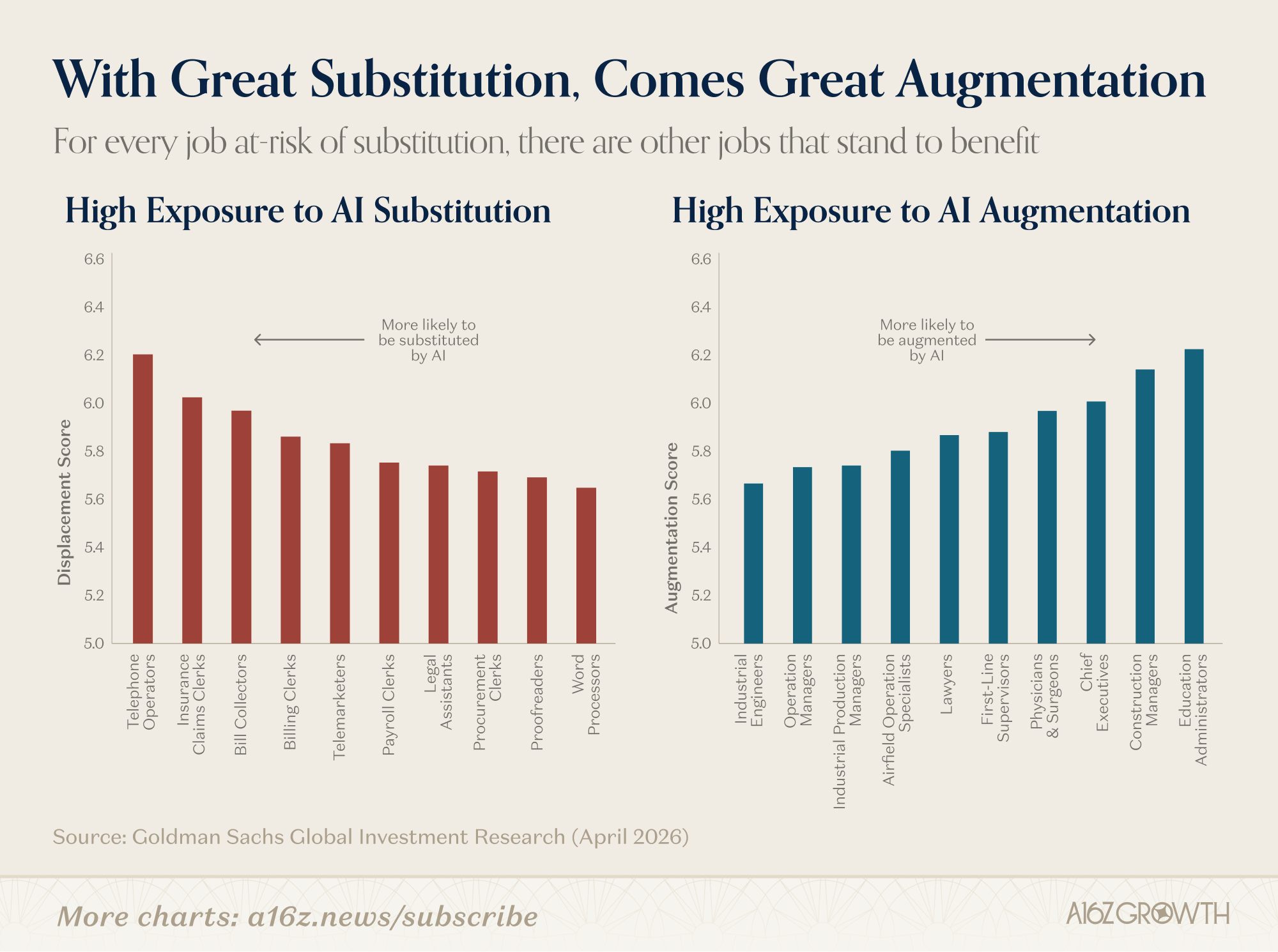
But the advocates of UBI go way beyond imaging that a currently nonexistent superintelligence will magically emerge from scaled-up LLMs. They add on top of this speculative scenario a further massive performance leap for humanoid robots capable of climbing ladders, laying bricks, planting crops, and performing the thousand physical tasks that define working-class labor, with the full range of dexterity, ingenuity, adaptability, delicacy and precision that humans innately possess.
Then they add to that scenario assumptions about the massive improvement in the batteries that will be necessary to power such robots through an entire workday.
Then, on top of this Mount Everest of wild speculation, they must further assume all of this will happen fast enough to produce a sudden employment catastrophe, rather than the gradual, sector-by-sector displacement that has characterized every previous wave of automation.
Maybe someday. But that day is nowhere in sight, and the history of technology suggests we consistently overestimate short-term disruption and underestimate humanity’s long-term capacity for adaptation.
The mechanized loom didn’t end all human employment. The tractor didn’t end employment. The spreadsheet didn’t end employment. They shifted it. Technology always shifts human productive capacity to new places. These shifts can be hard to envision before they emerge.
It’s easy to imagine job loss, but it is very difficult to envision entirely new categories of jobs emerging from the turmoil of a technological transformation. For instance, 20 years ago, before the triple-barrel blast of change delivered by smartphones, social media, and 5G mobile broadband, it would have been hard to imagine jobs like influencer, live streamer, IoT integrators, VR developers, social media managers, mobile marketers, gig economy workers, and the rest of the estimated 4 million jobs created in that wave. Human beings are hardwired to visualize loss, not emergent opportunity.
There is a second, more fundamental, reason to doubt the narrative that AI will take all the jobs. Humans have an innate drive to do productive work. Work provides structure, identity, and meaning that a transfer payment can never replicate.
UBI advocates react to this pushback by pointing to pilot data showing that most recipients do continue working. That is true, but it fails as a rebuttal because those pilots lasted two years at most, and participants knew the money was temporary, which proves nothing about the efficacy of UBI but instead demonstrates that participants were farsighted enough to refrain from burning all their career bridges during the pilot. Maybe they can find work as futurists.
The behavioral question of what happens across a generation, when an entire population has a guaranteed income floor with no end date, remains entirely unanswered by any evidence cited by UBI advocates.
That said, the serious version of this concern deserves a fair hearing. Historically, technological transitions have inflicted brutal damage to specific communities, even when the aggregate outcomes were positive.
The textile workers of Lancashire, the coal miners of Appalachia, the auto workers of Detroit, and so every local community whose jobs were destroyed by mechanization and automation; these workers gained no benefit from the aggregate productivity gains of industrialization. Their communities collapsed. The profits were captured by owners of capital. These examples illustrate the inherent unfairness of capital-biased technological change.
Concentrated displacement in specific sectors, demographics, and geographies is a real policy problem even if total employment doesn’t collapse. A truck driver in the Midwest losing his job to autonomous vehicles while a software engineer in Seattle thrives is a distributional crisis even if the aggregate employment figures look fine.
I believe that UBI, if it is truly universal in the sense that the income is made available to everyone, is the wrong answer to a localized problem. Like wielding a meat cleaver instead of a surgical scalpel.
But the problem is real, and it deserves a realistic policy response. In this context, discussion of UBI is little more than a distraction from the hard task of devising effective policy that is targeted towards the specific subset of the workforce who will be displaced by the next round of automation.
The UBI Math Doesn’t Work. At All.
Citizens of the United States already live extravagantly beyond their means. Why should the federal government be any different? The US government currently takes in nearly $4.9 trillion per year in revenue and spends a whopping $6.8 trillion. For fiscal year 2024, this left the nation saddled with a deficit of $1.8 trillion, according to the Congressional Budget Office. Since 2024, the gap has widened at the rate of $6.12 billion per day.
A trillion here, another trillion there, and it all starts to add up to real money.
The citizens of the USA now carry a national debt that exceeds $39 trillion. The interest payments on that debt reached $882 billion in 2024. That is more than spending on Medicare or national defense in the same year. And now the Pentagon, that monument to unaccountable spending, is seeking a 44% budget increase.
Armed with that context, let’s turn our attention to the dodgy math that supports proposals for UBI in the USA. Here, for reasons that will become clear in the ensuing paragraphs, I use the figures cited by former presidential candidate Andrew Yang.
The US population is approximately 330 million people, according to the Census Bureau. Andrew Yang’s proposal of $12,000 per year per adult works out to roughly $3.2 trillion annually if UBI is limited to only the adult population of 267 million rather than the total US population. The entire federal income tax haul in 2024 was about $2.4 trillion. We would need to increase income tax revenue by more than a third just to fund Yang's proposal, before paying for a single aircraft carrier, a mile of highway, or a dose of insulin for a Medicare recipient.
And Yang's number is far too small to matter, as we will see shortly. If the stated purpose of a UBI is to offset the total loss of income from the AI jobpocalyse, then a UBI designed as a replacement would cost considerably more than $2.4 trillion every year. The median individual income for American workers is approximately $40,000 per year. At 267 million adults, that comes to roughly $10.7 trillion annually just for the UBI payments, before a dollar is spent on anything else government currently does. Total adjusted gross income reported to the IRS runs to approximately $16 trillion per year. A UBI set at median individual income would consume two-thirds of every dollar of taxable income in the country.
Obviously, no candidate is proposing a UBI that will come anywhere close to the US median income. But anything less does not really solve the problem. $1000 a month certainly won’t. How did Yang arrive at that particular figure?
Yang’s policy legerdemain was to propose a UBI that was tiny enough to fit inside the already-huge federal budget, but this strikes me as a cynical ploy. In order to pre-empt legitimate criticism of his plan’s fiscal viability, Yang chose a monthly income that is too small to support a single person, let alone a family.
In other words, the version of UBI that is fiscally viable is meaningless, and the version that provides meaningful benefit is fiscally catastrophic. There is no number in between that solves both problems simultaneously.
Let’s consider the cost from a different angle. Suppose the AI job apocalypse really does occur, and a huge percentage of American workers subsequently lose their jobs. Citizens would demand relief. How much would it actually cost to replace their lost income?
The median household income in the US is $83,730. This figure is the more honest benchmark if the goal is to genuinely replace an entire household’s lost earnings due to the AI jobpocalypse. When we calculate a UBI based on this figure, the cost reaches $22.4 trillion, which exceeds total national personal income entirely.
If you disagree with median household income, you can plug in whatever number you think is adequate for a family to survive. This exercise reveals the absurdity of the UBI. You cannot tax your way to a number that actually solves the problem. It is a mathematical impossibility.
That’s how we arrive right back where this essay began: by borrowing the money. But if we fund today’s UBI with debt, that’s not really a UBI. That’s a transfer from future taxpayers to present consumers, laundered through a feel-good political program. It is, in the plainest possible terms, spending your grandchildren’s income because you’ve decided their future earnings are yours to allocate. And it is also a political time bomb that will eventually explode.
“Tax the Robots” Is Not a Serious Policy
Some smart technologists, such as Bill Gates, wave away the prospect of a massive fiscal crisis with a phrase: “Tax the robots.” It sounds clever. It isn’t. It’s glib.
Capital expenditures on equipment are already taxed. So what new tax mechanism are we actually proposing? On what equipment, exactly? A CNC machine displaced machinists in 1975. A spreadsheet displaced bookkeepers in 1985. An algorithm has been displacing traders since the 1990s. Microsoft Office did more to displace secretaries than any other invention.
Where exactly does “taxable AI automation” begin, and “legacy acceptable automation” end? The line is completely arbitrary, which means it will be drawn politically rather than rationally, which means it will be drawn badly.
A more sophisticated version of this idea, proposed by some serious economists, suggests the government ought to take equity stakes in companies that benefit from public infrastructure, government contracts, and publicly funded research. Over time, they surmise, returns from this sovereign wealth fund would finance a dividend that could be redistributed as UBI.
This is the most intellectually serious version of the funding argument, so I believe it demands a serious response, especially since a growing number of AI-era UBI advocates have updated it into a concrete proposal: according to them, the federal government should acquire equity stakes in the leading artificial intelligence laboratories and use the investment returns to fund a UBI.
The notion of the federal government taking an equity stake in a technology company may have seemed preposterous a few years ago, when the Washington’s laissez-faire stance allowed technology companies to grow without constraint. However, in August 2025, the Trump administration reached a deal for a roughly 10% equity stake in Intel as part of a $8.9 billion investment, converting federal CHIPS Act grants into company shares. The administration is now targeting sectors “critical to national security,” including AI, semiconductors and quantum computing.
This is getting real. So let us examine this idea more closely.
Taking a Stake in AI Labs is Sophistry That Doesn’t Survive Scrutiny
The argument has a surface plausibility that suggests it may be worth taking seriously. AI will generate enormous wealth, concentrated in a handful of laboratories and their investors. Why shouldn’t the public, whose tax dollars funded the underlying research, whose infrastructure runs the data centers, and whose labor trained the models, claim a share?
Under this proposal, the federal government would take equity stakes in AI companies, then build a national technology fund modeled on the Alaska Permanent Fund, and then distribute the returns as a universal income.
Clean. Elegant. Wrong.
The Alaska Permanent Fund works because Alaska owns the oil. The oil sits under public land, the state has negotiated royalties on its extraction, and those royalties were deposited into a diversified investment fund over four decades. The state did not have to seize anything from anyone; they cut a deal with private companies that wanted to take profitable advantage of a natural resource that was owned by the citizens of Alaska.
This model does not work for artificial intelligence. The AI laboratories are private companies built with private capital. The government owns no part of them, nor does it claim to own any resource utilized by these companies. To obtain equity, it must choose between three options, and every one is catastrophic.
Option one is seizure or forced transfer.
In other words, expropriation or nationalization. This would immediately trigger litigation that would cite Fifth Amendment takings, which if proven, would require just compensation at fair market value. That would defeat the fiscal purpose of the seizure. Moreover, confiscation would signal to every technology investor in the world that the United States government has conferred upon itself the right to seize equity in successful private companies. Foreign direct investment would collapse. Venture capital formation would freeze. The chilling effect on the very industry the US government is trying to tax would be swift, severe and permanent. It would destroy the incentive structure that produced the AI capability that UBI proponents are proposing to monetize.
Option two is a regulatory mandate.
In this scenario, Congress would require AI companies above a certain scale to issue equity to the government as a condition of operating in the United States. This is constitutionally dubious, and it would be litigated for a decade. It would also produce an immediate and predictable response: every major AI laboratory would migrate to reincorporate in a jurisdiction that imposes no such requirement. Ireland. Singapore. The United Arab Emirates. The Cayman Islands. You do not need to move people or even servers to relocate a corporation. OpenAI, Anthropic, and Google DeepMind would become foreign entities with US operations before the legislation clears committee. In the scenario, machinations by the federal government would accelerate the perverse outcome of exporting the very AI industry it was trying to tax, in exchange for nothing.
Option three is purchase at market value.
In this scenario, the government buys equity using tax revenue or borrowed money. In other words, the government would transfer wealth from taxpayers to AI shareholders, then return that wealth via UBI. The net transfer is approximately zero before administrative costs, and negative after them. This is not a funding mechanism. It is a shell game with a very expensive middleman.
Even setting aside acquisition, the valuation problem is unsolvable. At what price does the government take its stake? In March 2026, OpenAI was valued at $852 billion after its most recent funding round. Anthropic is currently in talks to raise a fresh round of financing at more than $900 billion, up from it’s February 2026 valuation of $380 billion. These are venture-capital valuations based on projected future earnings, not current profits.
Both companies are currently brazenly, shamelessly unprofitable, burning billions of dollars annually in compute costs. If the government buys in at those valuations, it is paying for speculative future value that may never materialize. If it demands a discount, existing shareholders have legal recourse. There is no price that is simultaneously fair to shareholders, affordable for the government, and large enough to generate meaningful UBI returns.
Then there is the liquidity problem. Even if the government obtained equity at a workable price, it cannot convert that equity to cash without a liquidity event, either an IPO or acquisition. Liquidity events are controlled by the companies and their existing shareholders. The government, as a minority equity holder with no governance rights, cannot compel one. It could end up holding illiquid paper for decades. How would this provide funding for a UBI? I think we know the answer: borrow money against the stock. We are right back at the beginning of the article.
The Alaska Permanent Fund holds publicly traded, diversified global assets that currently generate predictable income. That is considerably different from a stake in a startup AI lab.
A minority stake in a private company that may or may not go public, on a timeline not of the government’s choosing, at a price set by markets it does not control, is an entirely different instrument.
The proposal also fails to grapple with where AI value actually lives today. The most consequential AI deployments are not in private laboratories; they are embedded deep inside large public companies. Google’s search and advertising systems are AI-driven. Microsoft’s entire product suite runs on AI infrastructure. Amazon’s logistics, recommendation, and cloud businesses depend on machine learning at massive scale. Meta’s content ranking and advertising targeting are AI systems.
How do you isolate the “AI value” from a company whose AI is inseparable from everything else it does?
You cannot tax Microsoft’s AI revenue without taxing Microsoft. And once you are taxing Microsoft, you are back to the corporate income tax — which already exists, at a rate that is a separate political argument with no necessary connection to UBI.
There is a deeper structural problem that advocates of this approach appear not to have considered. If the federal government holds equity stakes in the leading AI companies, it then becomes a financial stakeholder in their continued market dominance. Every antitrust instinct that should be checking these companies’ power is neutralized by the government’s position as a co-owner.
Federal ownership creates a structural incentive for the federal government to protect AI oligopoly: to resist breakup orders, to block new entrants, and to preserve the concentration of market power that makes the equity valuable. This will not democratize artificial intelligence. It will create a massive barrier to new entrants. Funding the UBI with equity in the leading AI companies would turn the government into a silent partner with a direct financial interest in their monopoly. This is the opposite of the competitive, innovative market that distributes the benefits of technology broadly.
Finally, consider the timeline. The people supposedly being displaced by AI need income in the near term. Venture investment is a long-cycle gambit. Building equity stakes in AI labs, waiting for those companies to reach sustained profitability, waiting for a liquidity event or a dividend-generating scale of operations, then distributing returns as a monthly income, describes a process of twenty to thirty years at minimum, assuming everything goes right.
The most successful sovereign wealth fund in history, Norway’s Government Pension Fund, was built over four decades of North Sea oil royalties. A fund built on equity stakes in five AI companies that are currently burning cash is not a comparable instrument. The wealth does not exist yet. It cannot be built on the timeline the AI displacement argument requires.
What the AI equity stake proposal reveals is a recurring glitch in technology policy thinking. Its proponents are sophisticated enough to identify that AI creates concentrated value. But they are not sophisticated enough to design a mechanism that actually captures and redistributes that value evenly.
Identifying where value exists is the beginning of a policy question, not the answer to one. Every intermediate step, including acquisition method, constitutional authority, valuation, governance rights, liquidity, diversification, timeline, and international competitiveness effects, has been left undefined or incompletely answered.
The architects of actual sovereign wealth funds, from Alaska to Norway to Singapore, would find this proposal unrecognizable as serious policy. Laughable, even. It is a conclusion in search of a mechanism, dressed in the language of economic justice.
The Strongest Philosophical Argument for UBI and Why It Still Fails
Among the economists who responded to Van Parijs in the Boston Review, the most formidable for a UBI skeptic is Herbert Simon -- Nobel laureate, father of bounded rationality, and one of the most rigorous empirical thinkers of the twentieth century. Simon was not a utopian. His argument must be stated carefully because it is the best version of the funding case, and because it exposes a genuine tension that the straightforward fiscal critique does not fully resolve.
Simon’s claim: when we trace the causal factors behind American GDP honestly, at least two-thirds is attributable not to individual effort or private investment but to accumulated social capital that no individual created. Simon’s estimate of 70% is attributed to social capital that consists of the enormous body of scientific and technical knowledge built across centuries; and to organizational and governmental skills developed across generations; and to infrastructure paid for by previous taxpayers; and to the rule of law and contract enforcement that makes commerce possible; and to the simple accident of being born into a society where all of this exists.
Simon’s arithmetic: on a per-capita income of roughly $25,000 (as it stood in 2000), a 70 percent flat tax would generate enough to fund all existing government programs and still pay each American approximately $8,000 per year as a basic income. Because he estimated that individuals earn only about 10 percent of their income through their own effort (the rest being collectively inherited from social capital), even after paying 70 percent in tax, an individual would still keep roughly three times their genuinely earned share of their gross income, plus receive the $8,000 payment on top.
Van Parijs builds on a related philosophical foundation. His “real freedom” framework holds that justice requires maximizing the real -- not merely formal -- freedom of the least advantaged. Since real freedom depends on material resources, and since the distribution of those resources is overwhelmingly determined by morally arbitrary factors, such as whose parents you had, what country you were born into, what era you arrived in, how your talents happen to align with what markets currently reward, therefore a strong presumption exists in favor of unconditional redistribution. The surfer who chooses not to work is, on this view, merely a beneficiary of the same collective luck that the investment banker enjoys. The difference is one of degree, not of kind.
As preposterous as such claims may seem to readers in 2026, these are real arguments made by serious people. Rather than ignore them or dismiss them outright, let me offer a response that engages with them substantially.
Simon may be right that a large fraction of income in wealthy societies derives from collectively inherited social capital. But the inference he draws, namely, that this collective inheritance should be returned via universal cash payments, does not follow from the premise.
If the source of collective wealth is shared knowledge, infrastructure, institutions, and law, then the most direct way to return that wealth to everyone is to invest more in what is shared. For instance, universal healthcare would return the collectively generated capacity for medical treatment to everyone. Free higher education would return the accumulated knowledge to everyone. World-class public infrastructure would return collectively built physical capital to everyone. These instruments deliver the commons back as commons, that is, as shared resources that markets cannot price-discriminate against and that landlords cannot capture through rent increases.
A cash payment, by contrast, enters a market economy where it is immediately subject to repricing by those with pricing power. In housing markets with constrained supply (which describes every major American city) a universal cash transfer to citizens would flow directly from the government’s ledger into landlords’ pockets through rent increases. The same mechanism will inevitably operate in healthcare, education, and childcare.
Routing the commons through individual cash payments and collecting it on the other side for asset owners amounts to a radical redistribution of national wealth frozen in intangible assets to a small number of already-wealthy citizens. Simon’s moral premise may well be sound. His choice of instrument is wrong.
Van Parijs’s real-freedom framework faces a related problem. Even accepting that justice requires maximizing the real freedom of the least advantaged, a cash payment is not obviously the instrument that best achieves this. Real freedom, the actual capacity to pursue one’s aims, depends on health, education, housing stability, and social infrastructure as much as it depends on disposable income.
A person with reliable healthcare, good public schools, stable affordable housing, and accessible public transportation has more real freedom than a person with $12,000 annually who faces $36,000 in rent and $20,000 in medical bills. The philosophical framework, taken seriously, argues for a robust public sector. It does not specifically argue for unconditional cash.
How The Inflation Trap Will Devour the UBI
There is one point that almost never gets discussed in the polite company of futurists and forecasters: even if we managed to find a way fund a UBI, markets would rapidly reprice to absorb it.
If everyone suddenly has an extra $1,000 per month, what happens to rent? Landlords are not charities. They charge what the market will bear, and, thanks to the free federal money, the market will bear more.
This inflation risk is not uniform: it is worst precisely where the need is greatest. In cities where housing supply is legally constrained by zoning, permitting, and NIMBYism (which again describes almost every major American metropolitan area), the UBI would flow directly from the government’s ledger into the pockets of property owners. When inelastic supply meets expanded demand, prices tend to rise to absorb the transfer. In rural areas with more elastic housing supply, the inflationary effect would probably be smaller. But the people most at risk from automation-driven job loss are concentrated in cities and urban regions, not in low-cost rural markets.
The problem of inflation capture lands hardest on the people the program is supposed to help most. Moreover, this same dynamic operates in healthcare, education, and childcare, and in all sectors where supply is constrained and providers set prices based on what the market will bear.
UBI advocates point to small pilot programs, such as Stockton, California; GiveDirectly in Kenya; the Alaska Permanent Fund, as evidence that cash transfers don’t produce runaway inflation. These are not comparable. A small local pilot does not generate the aggregate demand shock that a nationwide program would. These pilots are genuinely interesting social science. They are not proof of concept for a federal program covering hundreds of millions of people.
Moreover, the income inequality argument cuts in an unexpected direction. Under a UBI regime where tech barons continue to accumulate massive gains, a fixed payment in an inflationary environment is a treadmill whereby recipients are obliged to run just to stay in place while asset owners compound. Capital returns will outpace wage growth; the UBI will get eroded by inflation; and then the gap will widen structurally.
UBI would actually be a gift to the asset-owning class. It might pacify labor while doing nothing to rebalance the capital-to-labor ratio.
The “Universal” in UBI Is a Lie Waiting to Happen
There is one genuine advantage that UBI has over the existing welfare state, and it is baked right into the name: universality. If everyone gets it, then there’s no stigma, no means-testing humiliation, no army of caseworkers deciding who deserves assistance. It’s simple. It’s dignified.
But when confronted with the impossible expense of providing a truly “universal” income to every citizen, proponents immediately backtrack by trimming the benefits to only “those who need it.”
In other words, even the most diehard supporters of UBI are not committed to the principal of universality: they propose a hard cutoff based on income or wealth.
The moment we begin to carve out exceptions, such as income thresholds, work requirements, sector targeting, age cutoffs, we jettison the only advantage UBI had over welfare.
If the nation were to proceed with a less-than-universal income, we would end up with yet another means-tested transfer program layered on top of all the creaking, old, cumbersome means-tested transfer programs already in existence, with all the same definitional fights, political battles, and bureaucratic overhead that were supposed to justify blowing up the old system in the first place.
And those fights will come. Every election cycle will devolve into a meanspirited negotiation over who is in and who is out. The program will feel unfair to whatever group is excluded, because it will be unfair to them. Vilification, epithets, and deeper polarization will follow.
“Universal” is meaningless. It’s just a branding exercise, not an accurate description.
Even sympathetic advocates concede the point. Brian Barry, a political philosopher who responded to Van Parijs in the Boston Review symposium and endorsed a subsistence-level UBI in principle, acknowledged that a below-subsistence basic income yields its claimed advantages “only in an attenuated form at best,” and that “the entire apparatus of welfare benefits would still have to remain in place.”
In other words, Barry, a UBI supporter, confirmed that the version of UBI that is fiscally arguable does not replace the welfare bureaucracy -- it sits on top of it. The administrative simplicity that is one of UBI’s core selling points evaporates entirely at the only price point our government can actually afford.
Barry also addressed the “participation income” variant. This is a version of UBI conditioned on performing some socially useful activity, paid or unpaid. Participation income has been proposed as a way of making unconditional income politically tolerable. His verdict was unsparing: it would require “a nightmarish scenario of an enormous bureaucracy entrusted with arbitrary monitoring powers.”
Any attempt to answer the political objection by adding conditions arrives at the same dead end. It reproduces exactly the bureaucratic complexity, means-testing humiliation, and administrative overhead that UBI was supposed to eliminate.
UBI is not a replacement for welfare. It is just another version of welfare, with all its warts and ugly moles.
The advocates are trapped: a truly universal, unconditional UBI is fiscally impossible at any meaningful level; a conditional, targeted version is what we already have, under a different name.
There is also a more subtle perverse outcome that would land hardest on those who can least bear it: a modest UBI layered on top of earned income could push some recipients into higher tax brackets, leaving them financially better off on paper without the actual benefit. The people least equipped to navigate this complexity are exactly the people the program is supposed to help.
A Better Tool Already Exists
What often gets lost in the UBI conversation is that the United States already has a mechanism for supporting people who are working but not quite making ends meet. It’s called the Earned Income Tax Credit. Most economists across the political spectrum consider it one of the more effective federal programs in existence. It is targeted, tied to earned income so it doesn’t disincentivize work, and has genuine bipartisan support.
The EITC is not perfect, and I believe that saying so openly strengthens rather than weakens the case against UBI.
EITC has documented flaws: roughly 20 percent of eligible recipients don’t claim it, partly because navigating a tax return is a barrier for the most vulnerable. Its phase-out structure creates marginal rate cliffs that can trap people in low-wage work. And crucially, it provides nothing for those who cannot work at all — the disabled, primary caregivers, the structurally unemployed.
These are serious problems that deserve real solutions: automatic enrollment, smoother phase-outs, and complementary programs for those outside the workforce. Every one of these flaws is fixable within the existing architecture, at a fraction of the cost and complexity of building an entirely new universal entitlement from scratch.
The choice is not between a perfect EITC and a perfect UBI. It is between a flawed program we know how to improve and a structurally impossible program whose advocates cannot agree on how to fund it.
Is the current version of EITC optimal? No. Does it need expansion and reform? Yes. But EITC demonstrates that targeted, efficient support for working people is achievable without constructing an entirely new universal entitlement system that collapses under its own fiscal weight.
The people who dismiss the EITC in favor of UBI are often not driven by evidence about what works. They are driven by the elegance of the UBI concept — a clean, simple, universal solution to a messy, complex problem. That is aesthetic reasoning, not policy reasoning.
The Thin End of the Socialist Wedge
To me, the defects in UBI are obvious: the math makes no sense, and the “income” on offer is nowhere near sufficient to meet anyone’s needs in any American city.
When a proposal simultaneously fails the sufficiency test and the fiscal test, the reasonable question is why serious people keep making it.
I suspect they may be playing a longer game.
The low number, such as Andrew Yang’s $1,000 per month, $12,000 per year, functions like a Trojan horse: let’s start with a constitutionally tolerable opening bid that is designed to normalize the principle of universal government income. Then, after that is enacted into law, the expansion can begin. Once 267 million Americans are receiving a monthly deposit from the federal government, the politics of reducing it will become nearly impossible, and the pressure to increase it will be intense.
I am not speculating about hidden motives. Van Parijs stated the strategy openly in the Boston Review in 2000: “The easiest and safest way forward is likely to consist of enacting a UBI first at a level below subsistence and then increasing it over time.”
What I describe as a Trojan horse, its leading philosopher describes as a deliberate transition strategy. The difference is one of framing, not of substance.
Yang’s low number is not a genuine income proposal. It is, by the advocates’ own account, a constitutional and political beachhead.
Andrew Yang’s $1,000 per month is not a living wage. In no major American city does $1,000 cover rent, let alone rent plus food, transportation, healthcare, and childcare. In many cities rent alone exceeds $3,000 per month. Yang’s number was not derived from what people actually need. It was derived from the largest figure that could be proposed without the fiscal math becoming instantly and catastrophically obvious.
Yang proposed a measly $1000 a month because anything more would have been laughed out of the room as fiscally naïve.
Advocates sometimes respond to this by reframing: UBI is meant to be a floor, not a full income replacement. People would still work; the UBI just provides a safety net beneath them.
This sounds reasonable until you examine it. A floor that doesn’t cover rent in any American city isn’t a floor, it’s a trapdoor. Rents will surely rise following the introduction of a UBI, but the UBI won’t.
Moreover it does not really address the main problem.
Yang’s stated goal was to protect people against the scenario where AI eliminates their jobs completely. In that scenario, a small supplement to income they no longer have is not a solution. It is a consolation prize.
Everyone on all sides of this debate agrees on the one scenario that provides a valid reason for considering the UBI: technological unemployment at mass scale. But this framing demands a full income replacement, not a tiny income supplement. If jobs still exist and people are still earning, then we already have the EITC for those who need support. No need for UBI.
The only scenario that truly justifies UBI is the one scenario where the UBI on offer is catastrophically inadequate.
Once 267 million American adults are receiving a monthly deposit from the federal government, the politics of ever reducing that payment will become almost impossible. Entitlements accrue constituencies. Constituencies vote. The program that begins as a modest supplement becomes, over a decade or two, an untouchable feature of political life, exactly as Social Security did, starting from a much smaller base in 1935 and expanding steadily for the next half century.
This makes a showdown over taxes inevitable.
The taxes raised to fund the initial, inadequate UBI will not come back down. The spending will only go up. The working people who still earn their money will be permanently saddled with a higher tax burden in exchange for a benefit that inflation will erode to irrelevance.
A population whose primary income derives from the state is also a population the state can coerce easily. Not dramatically, not overnight, but at the margin. The history of conditional welfare programs shows that once dependency is established, conditions tend to accumulate. Nobody living in Trump’s America can make a plausible argument for concentrating more leverage in the Oval Office over citizens.
There is also the opposite political pressure to consider: once the entire population is on a UBI, the wealthiest Americans will push relentlessly to cut it. After all, these are the people who benefit least from it and who will bear the most tax burden to fund it. The result: permanent, irresolvable political warfare over a single number that determines whether tens of millions of people can pay rent or eat. That is not a stable policy. That is a recipe for perpetual crisis.
What the Experiments Actually Show
The claim that “every UBI trial has been a smashing success” is repeated so often in futurist circles that it has acquired the status of received wisdom.
This claim is not accurate.
What the experiments actually show is considerably more complicated, and considerably more useful for thinking clearly about the policy.
Here is a tour of the major trials, what they found, and what their findings do and don’t prove.
1. Mincome — Manitoba, Canada (1974–1979)
The Manitoba Basic Annual Income Experiment — Mincome — was a Canadian guaranteed annual income experiment funded jointly by the Manitoba provincial government and the federal government under Prime Minister Pierre Trudeau. It was one of the first examples of a UBI program applied to an entire community.
The health results were striking. A quasi-experimental analysis found an 8.5 percent reduction in the hospitalization rate for participants relative to controls, particularly for accidents, injuries, and mental health. More adolescents continued into grade 12 rather than entering the workforce early. On work disincentives, a small reduction in work effort did exist in the short run — but the two groups most likely to reduce hours were new mothers and teenagers staying in school, outcomes most people would consider positive.
The critical catch: by the time data collection was completed in 1978, interest in the guaranteed income was on the wane, and the Canadian government cancelled the project before the data was analyzed. The raw data sat in filing boxes for decades. The oil shocks and stagflation of the 1970s brought different governments to power, and brought Mincome to an end without any implementation of the anticipated universal program.
What this means: the experiment was cancelled by fiscal reality. The same fiscal reality would confront any national program. The health improvements are real and interesting but were observed over five years in one Canadian province, not scaled to a continent-wide population.
2. The Alaska Permanent Fund Dividend (1982–present)
The Permanent Fund Dividend is a dividend paid to Alaska residents who have lived within the state for a full calendar year. It is funded by petroleum royalties deposited into a permanent investment fund. The largest dividend ever paid was during Sarah Palin’s governorship in 2008, at $3,269 per resident. The program is popular across the political spectrum and has run continuously for over forty years, making it the most durable example of unconditional cash transfers in the US.
Research found no significant reduction in aggregate employment as a result of the dividend. Poverty rates among Alaska’s Native population declined. By these measures it works.
The critical catch: while the Alaska Permanent Fund Dividend is unconditional and universal, economists note that the amount is still too small to classify it as a true UBI in the sense of providing a living income. More importantly, it is funded by oil royalties from a finite, price-volatile natural resource, not by taxes or borrowing. The US has no comparable resource endowment that could fund $12,000 per year for 267 million adults. The math is not transferable.
Meanwhile, Alaska is already experiencing the political ratchet problem at small scale. The failure of Alaska’s governor to consider any reduction to the dividend is forcing cuts to public education, with arts departments and school sports shuttered as a result of the fiscal tension. Alaska is a preview of what national-scale dependency would produce.
3. Finland (2017–2018)
Finland ran Europe’s first national, government-backed basic income experiment. Two thousand randomly selected unemployed people received €560 (approximately $620) per month for two years, with no obligation to seek work and no reduction if they took a job. The goal was to test whether removing benefit withdrawal penalties would encourage people to accept low-paid or temporary work.
The results: recipients were more satisfied with their lives and experienced less mental strain than the control group. On employment, the basic income group averaged 78 days of work over the measured period, versus 73 for the control group — a marginal difference that led the University of Helsinki to conclude the experiment cast “serious doubt on popular beliefs about basic income and employment.” In their words: carrots do not seem to matter, but sticks are welcomed.
The critical catch: the scheme was not strictly a universal basic income trial. Recipients came from a restricted group of unemployed people and the payments were not enough to live on. Most importantly, Finland conducted the first nationwide basic income field experiment and then did not implement the policy as a result of it. The experiment had no impact on Finland’s Social Security 2030 project or its Social Security Reform Committee. The country that ran the most rigorous test looked at the results and declined to proceed.
4. Stockton SEED — California, USA (2019–2021)
The Stockton Economic Empowerment Demonstration provided 125 residents of low-income neighborhoods with $500 per month for two years, funded privately. Recipients showed improved mental health, reduced income volatility, and somewhat better employment outcomes than the control group. The money was spent on food, utilities, and basic necessities.
The critical catch: the problems with SEED as evidence for national UBI are significant. The sample was 125 people — that’s not a typo! — in one low-income neighborhood of one California city. It lasted two years, and researchers note that people are unlikely to exit the labor force when they know the money is temporary. Among US guaranteed income pilots more broadly, the average attrition rate was 37 percent, which can badly distort reported results. The program was privately funded, telling us nothing about what happens when you must raise taxes to pay for it at national scale.
SEED is evidence that giving poor people cash doesn’t make them irresponsible. That is a useful and humanizing finding. It is not evidence that a national UBI is fiscally viable, inflation-resistant, or superior to targeted interventions.
5. Kenya — GiveDirectly (2016–ongoing)
GiveDirectly is running the world’s largest and longest-term UBI study, with a budget of $30 million. Approximately 20,000 recipients from 195 rural villages in Kenya are receiving regular payments for periods of two to twelve years, depending on study group. Early results show lower food insecurity, better physical and mental health, and motivation to start small businesses.
The critical catch: the relevance to the United States is essentially zero. Rural subsistence poverty in Kenya and urban precarity in America are not comparable conditions. The economic structure, labor markets, inflation dynamics, cost of living, and existing social safety net differ so completely that findings cannot be extrapolated. Cash transfers to people with no income floor in a low-income economy will predictably improve outcomes. That finding says nothing about whether adding $1,000 per month on top of America’s existing welfare state produces the same results at national scale.
The Big Picture: What 122 US Experiments Show
The most comprehensive recent analysis comes from an American Enterprise Institute study covering 122 guaranteed basic income pilots across 33 states between 2017 and 2025. The mean annualized payment was $7,177 per recipient. The AEI’s conclusion is deliberately cautious: these findings may not generalize to a permanent, universal, nationwide UBI under current or future conditions.
The studies varied widely in payment size, duration, sample composition, and how outcomes were measured. Some relied heavily on self-reported survey data. Some were conducted during or immediately after the COVID period, when labor markets and personal decisions were anything but normal. Average attrition across pilots was 37 percent, a methodological red flag that can dramatically skew reported results.
The Honest Verdict
Across every experiment, the consistent findings are: cash transfers improve wellbeing, don’t destroy the work ethic in the short run, and are spent more responsibly than critics predict. These are positive findings that should inform how we think about poverty policy.
What the experiments do not show — and cannot show — is whether a permanent, national, universally funded UBI is fiscally sustainable, inflation-resistant, or superior to targeted interventions. Every single experiment was time-limited, meaning recipients knew that the money would end and adjusted their behavior accordingly. Every experiment was externally funded, telling us nothing about what happens when you have to raise the taxes to pay for it. And the most-cited “experiments,” Alaska and Stockton, fail the universality test that is the entire philosophical premise of UBI.
“Every trial has been a smashing success” is a grotesque distortion. At best it is an overhyped marketing claim, not a valid research finding.
The honest reading of the evidence is: small cash transfers to specific populations over limited periods produce measurable wellbeing improvements and do not collapse labor markets.
Whether that scales to a permanent federal program covering an entire nation is a question no experiment has come close to answering, for the simple reason that answering it would require running the experiment at full scale, which is exactly what the advocates are proposing.
That is not evidence-based policymaking. That is using evidence to launder a conclusion that the evidence does not support.
What a Pragmatic Futurist Should Say
The futurists who keep proposing UBI on my podcast are not bad people. Many of them are quite brilliant in their domains. But brilliance applied to a bad idea produces a sophisticated bad idea, not a good one. And the sophistication makes it more dangerous, not less, because it makes the flawed arithmetic harder to see.
Putting lipstick on a pig may surprise and distract some people, but it won’t change the swinish facts on the ground and underfoot.
The honest policy response to automation-driven displacement is not a universal entitlement that fails the fiscal test, the inflation test, the political stability test, the universality test, and the sufficiency test, all simultaneously, not alternatively.
If we must reach for a policy before the impact of AI is truly understood, then let’s reach for one that is targeted, fiscally grounded, and built on mechanisms we know work: an expanded and reformed Earned Income Tax Credit, portable benefits that are not tied to specific employers, serious investment in job retraining, and real housing supply reform to make cities affordable rather than subsidizing landlords to charge more.
The UBI math does not work. The inflationary response will eat the money. The political ratchet will lock in the taxes while eroding the benefit. The “universal” will become a fiction. The dependency will become a vulnerability.
I’ve asked my guests the hard questions about UBI. Their answers have not been satisfying. Until they are, I’ll keep asking.
Rob Tercek is the co-host of The Futurists podcast and the author of Vaporized. This Substack examines how new technologies like artificial intelligence will reshape entire industries and society.
Wow. 100% agree. Awesome arguments, beautifully written.
Social Security is a UBI based on age (pointing out, mildly). A small UBI doesn’t solve problems at scale, but its emotional value is probably more powerful than we realize and could in itself drive confidence and economic growth. I would certainly rather put money in a UBI than a lot of other places where government funding is going.